Research-led buying guide · Home & workshop
Best rechargeable AA and AAA batteries and chargers
Build a rechargeable AA and AAA kit with low-self-discharge NiMH cells and individual-slot chargers. Compare capacity, kit contents and charging limits.
Quick answer
Best rechargeable AA and AAA batteries and chargers: the quick answer
The best rechargeable AA and AAA batteries for an emergency kit are compatible cells you keep charged in matched sets. Standard Panasonic eneloop cells have clearer storage and charging documentation than many high-capacity marketplace packs. Start with the BQ-CC55 kit for four AA cells and an independent-slot charger; add the loose AA or AAA packs only in the quantities your equipment needs. The Nitecore D4 is a specialist charger alternative.
- 01
Choose the BQ-CC55 kit if you need both a charger and your first AA set. Do not accidentally buy another four loose AA cells expecting a charger.
- 02
Add AAA packs for compatible head torches. A light using three AAA needs six cells for one installed and one spare set; one four-pack cannot provide that.
- 03
Choose the D4 if you also maintain supported cylindrical lithium cells and understand its settings. It is slower and more complicated than most NiMH-only households need.
The picks
The researched shortlist
These are exact Amazon UK source listings. Prices and stock were checked on 29 October 2026 and vary by seller, delivery address and country. Any offer at purchase takes precedence.
Panasonic eneloop AA rechargeable batteries, four-pack
Best for: An existing NiMH charger or a second matched AA set
The reason to choose standard eneloop is a documented low-self-discharge design, not the largest number printed on a wrapper. This exact older pack is rated at 1900mAh minimum per AA cell. Panasonic’s retention claims are useful evidence for storage use, but a ten-year laboratory headline is not permission to leave a household kit unchecked. Charge, label and test the set in the actual radio or torch before relying on it.
- Low-self-discharge design suits maintained spare sets
- Common AA format supports compatible radios and torches
- Standard-capacity cells avoid prioritising maximum capacity over recharge life
- Four loose cells do not include a charger
- 1.2V chemistry is not approved for every AA device
- Marketplace seller and exact pack revision still need checking
Panasonic eneloop AAA rechargeable batteries, four-pack
Best for: Compatible three-AAA head torches and other small devices
This is the smaller cell format, not a lower-performance substitute for AA. Buy it because your equipment needs AAA. Standard eneloop AAA gives 750mAh minimum in this pack revision and can use the BQ-CC55’s independently monitored slots. That makes a three-cell head torch easier to maintain than a charger that insists on pairs. Buy enough cells for complete sets rather than mixing the unused fourth cell with older batteries.
- Fits compatible AAA head torches without a proprietary pack
- Same appropriate NiMH charger can maintain AA and AAA
- Low-self-discharge design is useful for stored spare sets
- Four-pack quantity is awkward for three-cell devices
- No charger included
- Less energy per cell than AA, so small-format convenience costs runtime
Panasonic eneloop SmartPlus BQ-CC55 charger with four AA cells, UK kit
Best for: Most homes starting a compatible rechargeable AA/AAA system
At the checked price, this is better value than buying loose AA cells and then forgetting the charger. Each slot is monitored separately, so it can charge a three-cell set and mixed AA/AAA sizes without forcing matched pairs into the charger. Panasonic rates one or two standard AA cells at about 1.5 hours, or three/four at about three hours. The kit lists AA cells as 2000mAh without clearly distinguishing minimum from typical capacity. This is not proof of a higher minimum than the loose AA pack.
- Includes four AA cells and an independent-slot charger
- Charges one to four AA/AAA in different combinations
- Separate indicators show each cell’s progress
- Mains input means it cannot refill cells from an ordinary USB bank
- Four-cell charging takes about twice the headline 1.5-hour time
- No capacity-testing or recovery programme; ageing-cell rejection can frustrate owners
Nitecore D4 Digicharger with LCD
Best for: Readers also charging supported 18650-type cells and willing to use the manual
The extra capability is chemistry and size flexibility, not faster AA charging. The display makes current, voltage and elapsed time visible, and each supported cell is monitored separately. Four cells share the available current, roughly 375mA each at the standard setting. AAA cells benefit from the manual low-current setting; read the instructions rather than assuming automatic size detection makes every setting suitable. HKJ’s bench tests support its charging behaviour, but this is not a battery-capacity analyser.
- Handles supported NiMH and cylindrical rechargeable lithium cells
- Independent display shows current, voltage and elapsed time
- Low-current option helps accommodate smaller cells
- Slower with all four slots occupied; slot sharing complicates timing
- Manual low-current selection and chemistry options add complexity
- Does not measure usable cell capacity, and cannot charge from USB
Capacity and recharge-life claims need context
Capacity and recharge-life claims need context
A larger mAh number can mean longer use in a compatible device, but it does not settle charge retention, cycle life or quality. Standard eneloop AA and AAA were selected over eneloop Pro for a maintained emergency kit because the standard family prioritises retention and recharge life. Pro may make sense for frequent high-drain work, but its higher capacity comes with lower manufacturer cycle-life claims.
Panasonic publishes both older and newer cycle-test methods. A headline such as 2100 recharges uses a different test basis from a newer IEC figure; neither promises 2100 full household charge/discharge cycles. Its long storage-retention claims are laboratory conditions, including controlled temperature. The exact loose MCCE packs here carry 1900mAh-minimum AA and 750mAh-minimum AAA specifications; the BQ-CC55 kit listing says 2000mAh without a clear minimum-versus-typical distinction.
Label complete sets with purchase date and device. Keep cells of the same chemistry, model and similar age together in use. Charge them before storage, check the kit periodically and test at a useful light level or listening volume. A charger can report full without proving the cell still has its original capacity. Replace a set that no longer provides the reserve you need.
Your charger does not create power in an outage
Your charger does not create power in an outage
Both selected chargers need an external electrical supply. The BQ-CC55 uses mains; the D4 accepts mains or a suitable 12V DC supply, not direct USB. Charge spare sets while power is available. Neither is a complete blackout charging solution, and an ordinary USB phone bank cannot be connected directly to their AC or 12V input.
The BQ-CC55 is the simpler first buy because its kit includes four AA cells. Add AAA only for equipment that requires it, and buy a second complete set if replacement rather than immediate recharging is your plan. The D4 makes sense if you already use supported cylindrical lithium cells and can follow its chemistry/current instructions. Its voltage/current display does not measure how many mAh a worn cell can deliver.
For a practical three-AAA head torch, two four-packs provide an installed set, a complete spare set and two extra cells. Keep sets labelled; do not build a working set from assorted old leftovers. Check the device’s NiMH permission first, especially where manufacturer instructions specify alkaline only.
When another battery system makes more sense
When another battery system makes more sense
IKEA LADDA cells were considered, but no suitably verified exact Amazon UK offer was established for this shortlist. Eneloop Pro is an alternative for frequent high-drain use, not an automatic upgrade for stored emergency equipment. A basic pair-only or fixed-timer charger costs less, but is a poor fit for three-cell lights and ageing sets.
Rechargeable 1.5V lithium AA products and USB-port cells use different charging arrangements. They are not interchangeable with NiMH in these chargers. Ordinary alkaline and primary lithium AA cells must never be charged here. A compatible disposable spare set can still be sensible if you will not maintain rechargeables; check its storage and equipment instructions.
Match the chemistry and charger
Match the chemistry and charger
Similar dimensions do not mean the same voltage or charging method.
- Use only rechargeable chemistries and sizes specifically permitted by the charger and equipment. Never charge ordinary disposable alkaline or primary lithium cells.
- Never put a 3.7V 14500 lithium cell in an AA appliance merely because it fits. Follow all manual chemistry selections.
- Do not mix old/new cells, brands, capacities or chemistries in a working set. Store spare cells in cases away from metal objects.
- Charge on a dry uncovered surface, monitor as directed and stop for damage, leakage or abnormal heat. Do not bypass rejected-cell warnings.
- Remove stored cells from equipment when its maker advises, inspect contacts and recycle worn batteries through an appropriate local collection route.
How we chose
How we chose
This is desk research, with no hands-on testing by The Consumer Library. Manufacturer documentation anchors specifications; named independent reviewers supply their own observations. Owner comments help identify recurring usability issues, but cannot establish failure rates or certify performance. Retailer ratings can combine colours, revisions and older products. We compared the alternatives discussed in this guide and selected products for a specific job at their checked prices.
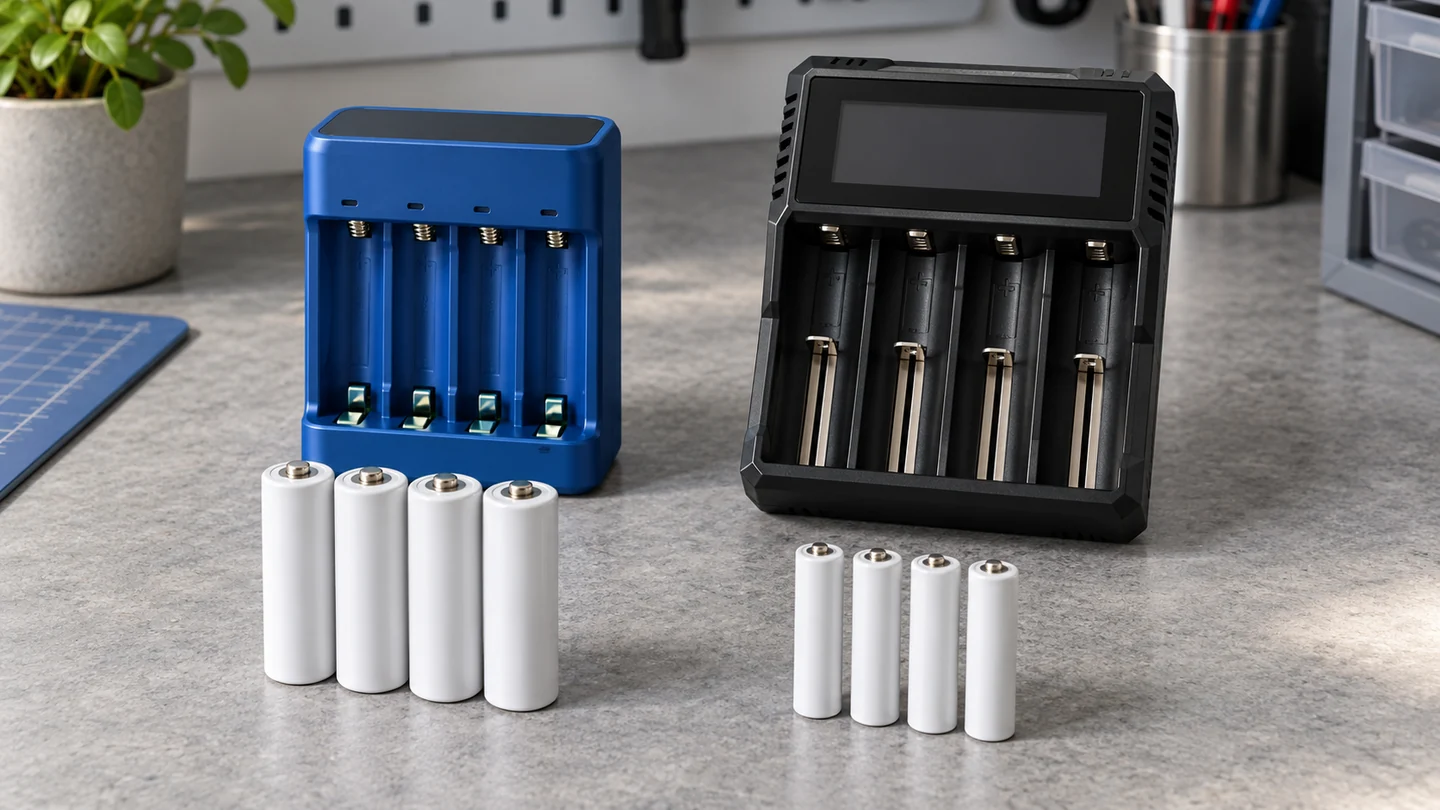
The hero is an AI-generated illustration of representative shortlisted product types, not a photograph of review samples. Browse [Home & workshop](/category/home-workshop) for related buying questions.
Sources
Sources and checking notes
All pages below were checked on 29 October 2026. Publication dates, where available, are included in the notes; an undated page has a checked date, not an invented publication date. Retailer stock is a snapshot.
-
01
Panasonic — eneloop lineup and test notes
Current standard/Pro capacities, storage-retention conditions and different cycle-life test methods. Marketing maxima are not expected household cycle counts.
Open source -
02
Panasonic — standard eneloop cells
1.2V NiMH and standard AA/AAA minimum-versus-typical capacity context. Exact retail pack generation is identified separately.
Open source -
03
Panasonic — BQ-CC55 charger
Individual AA/AAA slots, occupancy-dependent 1.5h/3h times, mains supply and indicator meanings. Checked current documentation; no new test invented.
Open source -
04
Nitecore — D4
Supported sizes/chemistries, 100–240V AC/12V DC input, four-slot current sharing and display functions.
Open source -
05
HKJ / lygte-info — BQ-CC55 bench review
Undated instrumented exact-model charging/thermal tests. Individual termination and relatively critical cell rejection. UK in this site’s URL denotes English text, not proof of the retail plug.
Open source -
06
HKJ / lygte-info — D4 bench review
Undated older exact-model bench test: current sharing, low-current selection, NiMH termination and unplugged cell drain. Not a current-batch longevity test.
Open source -
07
r/batteries — BQ-CC55 versus CC17 owners
2 Jan 2023 onward. Owners discuss older-cell rejection and charging speed. Anecdotal self-selected comments; corroborating issue signal, not a measured failure rate.
Open source -
08
r/batteries — BQ-CC55 rejection discussion
13 Nov 2023 onward, with later follow-ups. Recurring rejection reports, including Pro cells; not all standard cells affected. Unsafe suggested workarounds were not adopted.
Open source -
09
Amazon UK — eneloop AA BK-3MCCE/4BE
Browser check: £14.95 new, in stock; four loose AA cells, no charger. Old-generation specification kept distinct from newer kits.
Open source -
10
Amazon UK — eneloop AAA BK-4MCCE/4BE
Browser check: £11.98 new, nine left; four AAA cells, no charger. Review pool includes related packs/revisions.
Open source -
11
Amazon UK — BQ-CC55 SmartPlus UK four-AA kit
Browser check: £33.60 new, eoutlet-uk, one left; separate Resale offer excluded. Four AA listed as 2000mAh, minimum/typical not clear. Owners 20 Oct/27 Nov 2025 praise individual status; a 15 Dec 2024 owner misreads green as finished, checked against manual.
Open source -
12
Amazon UK — Nitecore D4
Browser check: £36.18 new, 15 left, delivery offered. Display usability recurs in Nov 2015/May 2016/Jan 2018 owners; April 2017 owner identifies lack of capacity measurement. Old reviews are labelled as such.
Open source
Guide information and links checked 29 October 2026.