Buying guide · Craft & making
The best pre-cut chainmail rings for beginners
Start with the weave, not a mystery bag.
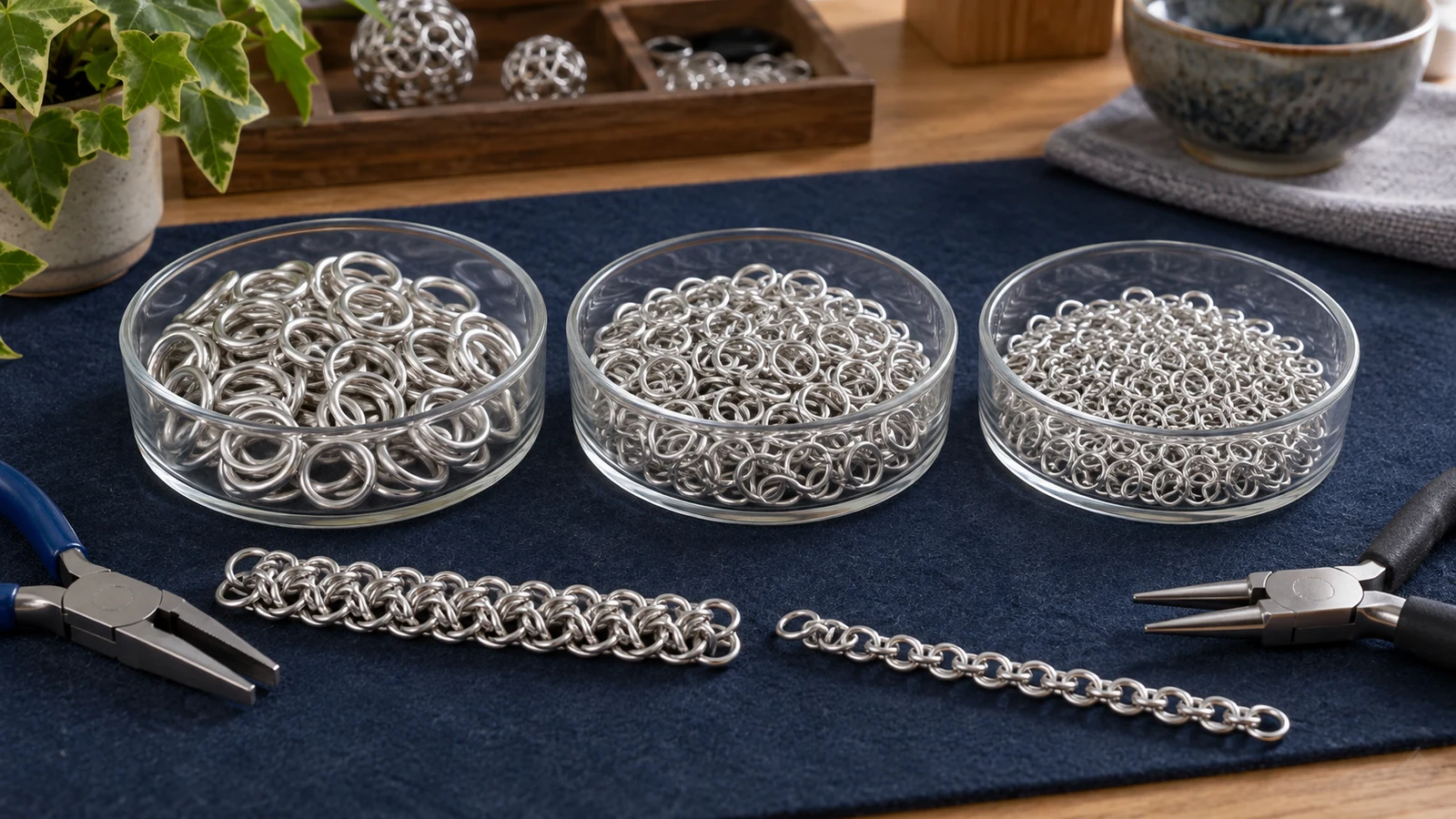
Chainmail Joe's 16 SWG 1/4-inch bright-aluminium rings are the most forgiving first buy. The two 18 SWG options trade strength and easy closure for lighter jewellery or the larger aspect ratio needed by airier weaves.
Quick answer
Which pre-cut rings should a beginner buy?
For a first European 4-in-1 swatch, buy the 16 SWG 1/4-inch rings. Their aspect ratio is close to 4, the wire is substantial enough to grip, and bright aluminium is light and comparatively forgiving.
- 01
Pick 16 SWG 1/4-inch for European 4-in-1, box chain and a broad range of beginner samples.
- 02
Pick 18 SWG 7/32-inch when you want a lighter, finer result while keeping an aspect ratio near 4.6.
- 03
Pick 18 SWG 9/32-inch only for a pattern that calls for an aspect ratio around 6.2, such as European 6-in-1 or King's Mail.
The picks
The three ring sizes
All three are one-pound bags of saw-cut Chainmail Joe bright-aluminium rings. They are alternatives for different weaves, not a simple good-better-best ladder.
Chainmail Joe Bright Aluminium Rings 16G 1/4-inch ID
Best for: European 4-in-1, box chain and beginners who want one useful practice size
The 1.6 mm wire is easy to see and grip, while the 6.4 mm opening produces an aspect ratio of 4: a familiar, controlled fit for European 4-in-1. The saw cut helps the ends meet more neatly than pinch-cut craft rings, and a one-pound bag leaves enough material to learn consistent closure and make more than a token swatch.
- Named 5356 alloy, cut, wire diameter, inner diameter and aspect ratio
- AR 4 is a dependable reference point for firm European 4-in-1
- Thicker 1.6 mm wire is easier for a beginner to hold and inspect
- One-pound quantity costs more than a small sampler
- Finished mail is bulkier than 18 SWG jewellery-scale work
Chainmail Joe Bright Aluminium Rings 18G 7/32-inch ID
Best for: Small decorative pieces and lighter European-style weaves once basic closure feels controlled
The 1.2 mm wire makes a noticeably finer and lighter fabric than the 16 SWG default, while the 5.5 mm opening preserves a workable AR 4.6. The one-pound bag contains roughly twice as many rings as the thicker pick, which is useful when a planned jewellery or costume project genuinely needs the smaller scale.
- Finer 1.2 mm wire gives a lighter, less chunky result
- AR 4.6 remains useful for common European-style patterns
- About 7,200 rings supports larger projects at a small scale
- Less forgiving of heavy plier pressure and repeated reopening
- Smaller rings are slower to sort and close neatly
Chainmail Joe Bright Aluminium Rings 18G 9/32-inch ID
Best for: European 6-in-1, King's Mail and other open patterns specified around aspect ratio 6
This ring keeps the fine 1.2 mm wire but increases the opening to 7.2 mm, producing the space needed by denser-link-count or deliberately airy patterns. Chainmail Joe names European 6-in-1 and King's Mail among its intended uses, making it a traceable specialist choice rather than a guessed substitute.
- Published AR 6.2 removes guesswork for higher-AR patterns
- Fine wire keeps large-opening mail relatively light
- Saw-cut ends support cleaner closure than generic craft jump rings
- Poor general-purpose first size for European 4-in-1
- Large opening leaves more scope for soft aluminium rings to distort
Trade-offs
What the size changes
Gauge alone is not enough. The wire diameter and ring inner diameter combine to create aspect ratio, which determines whether a weave is comfortable, loose or impossible.
16 SWG · 1/4 in · AR 4
The thickest wire here gives a beginner more surface to hold and produces a firm European 4-in-1 fabric. It is the safest default when the first goal is technique rather than delicate jewellery.
18 SWG · 7/32 in · AR 4.6
Thinner 1.2 mm wire makes the finished piece lighter and more jewellery-like. The ring is also easier to deform by over-gripping, so neat closure matters.
18 SWG · 9/32 in · AR 6.2
The larger opening is intentionally loose for higher-AR patterns. It is a poor substitute for the AR 4 starter ring because European 4-in-1 will feel open and sparse.
How we chose
How we chose beginner chainmail rings
We prioritised a named alloy, explicit wire and inner diameters, a published aspect ratio, a clean saw cut and an exact Amazon UK listing. Chainmail Joe's own size table was checked against specialist weave references and current beginner discussions. Amazon pages supplied the live UK offer, bag quantity and review context; ratings were not treated as performance testing.
Only bright aluminium is included because it is light, easy to manipulate and inexpensive enough for practice. The three sizes are intentionally task categories: the 16 SWG 1/4-inch ring is the broad beginner default, the 18 SWG 7/32-inch ring is a finer alternative, and the 18 SWG 9/32-inch ring is a specialist high-AR choice. Generic mixed jump-ring boxes were rejected because they rarely state alloy, cut or aspect ratio. Other Chainmail Joe sizes and a complete kit were considered, but a beginner is better served by choosing one known weave and one known size.
Use and care
Use, storage and fit checks
Pre-cut rings remove coil cutting, but they still need inspection and controlled handling.
- Confirm the tutorial's actual wire diameter, inner diameter and target aspect ratio. Gauge systems differ: 16 SWG is not the same diameter as 16 AWG.
- Use two smooth-jaw pliers and twist the ring ends past each other. Do not pull them sideways, which changes the circle and weakens the closure.
- Aim for flush, aligned ends. Discard rings with sharp burrs, deep tool marks, cracks or ends that cannot be brought together cleanly.
- Keep rings sorted and labelled. A few tenths of a millimetre can change a weave, and loose sizes are hard to identify by eye.
- Bright aluminium is for decorative chainmail, not protective equipment, climbing, restraints or any load-bearing use.
Sources
Sources and checking notes
Size and alloy data come from the maker and exact product pages; weave fit and beginner cautions are cross-checked against specialist references and current community experience.
-
01
The Hobby Library · Chainmail Making
Beginner context for two-plier technique, bright-aluminium practice and a first European 4-in-1 swatch.
Open source -
02
Chainmail Joe · Bright aluminium rings in bulk
Manufacturer alloy, saw-cut process, dimensions, ring counts, aspect ratios and suggested weaves for the shortlisted sizes.
Open source -
03
Chainmail Joe · Complete chainmail kit
Manufacturer context on commonly taught weave families and the ring sizes used in its structured starter kit.
Open source -
04
Chainmaillers · European 4-in-1 weave
Specialist weave reference documenting a working aspect ratio close to 4 for European 4-in-1.
Open source -
05
Zlosk · European 4-in-1
Long-running technical chainmail reference placing the useful European 4-in-1 aspect-ratio range around 4 to 5.
Open source -
06
r/chainmailartisans · Where to buy beginner rings
Current beginner discussion repeatedly favouring named ring suppliers, bright aluminium and known sizes over anonymous assortments.
Open source -
07
r/chainmailartisans · Ring choice for a beginner
Owner discussion on bright aluminium as a forgiving starter material and on matching ring size to a weave rather than buying by gauge alone.
Open source -
08
Amazon UK · Chainmail Joe 16G 1/4-inch rings
Exact one-pound bright-aluminium 16G 1/4-inch listing checked live for price, availability, ring count and dimensions.
Open source -
09
Amazon UK · Chainmail Joe 18G 7/32-inch rings
Exact one-pound bright-aluminium 18G 7/32-inch listing checked live for price, availability, ring count and dimensions.
Open source -
10
Amazon UK · Chainmail Joe 18G 9/32-inch rings
Exact one-pound bright-aluminium 18G 9/32-inch listing checked live for price, availability, ring count and dimensions.
Open source
Guide information and links checked 14 September 2026.