Buying guide · Craft & making
The best sanding sticks for plastic model making
Buy a grit sequence, not one miracle file.
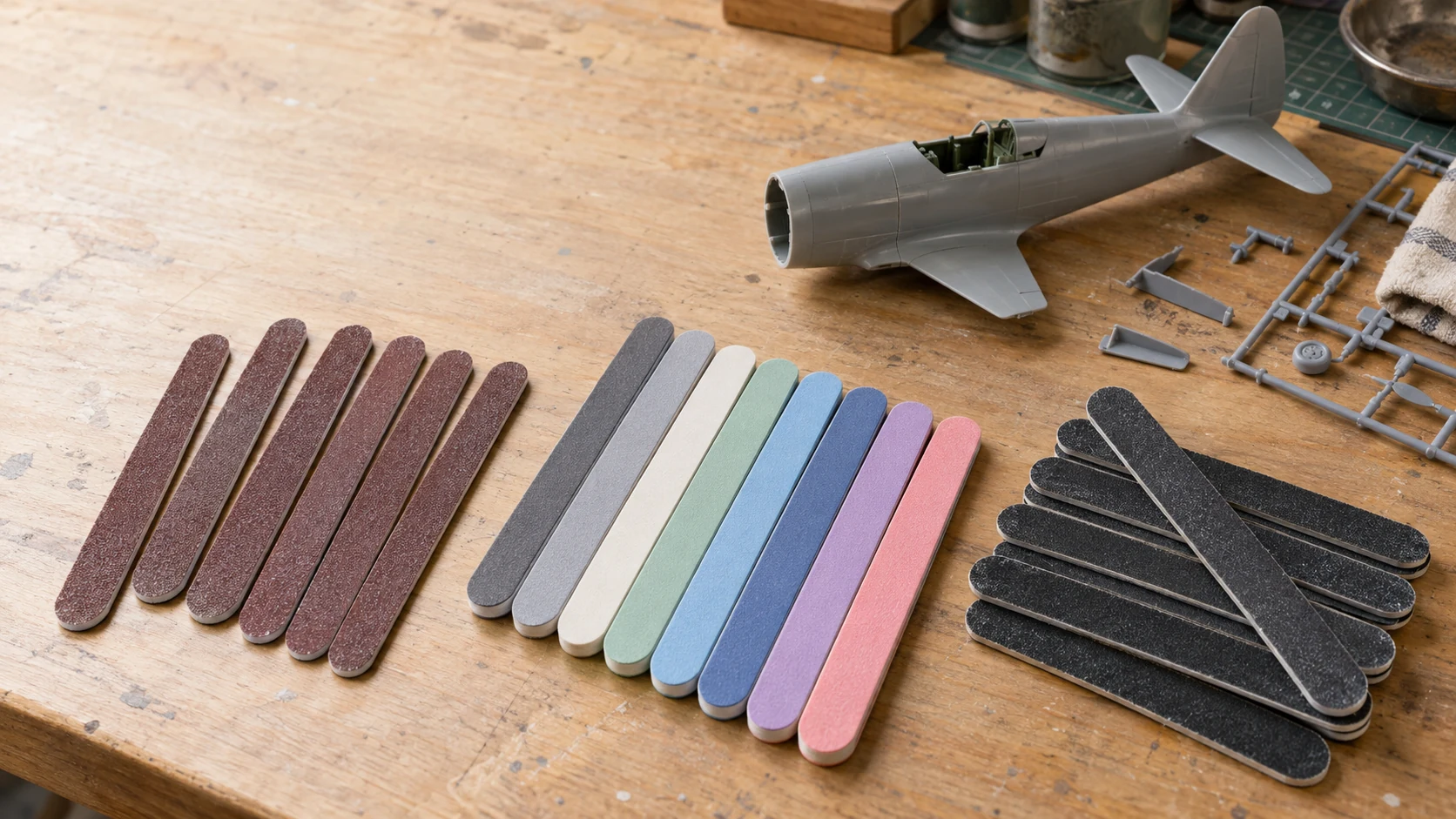
Infini Model's eight-stick set is the most complete route from seam removal to polishing. Revell's inexpensive coarse sticks handle fast initial cleanup, while Honoson's 20-piece pack is the replaceable value option.
Quick answer
Which sanding sticks should you buy?
Choose Infini if you want one coherent system for visible seams and clear-part finishing. Add Revell for fast coarse shaping, or choose Honoson when quantity and replaceability matter more than a documented grit ladder.
- 01
Infini's cushioned sticks follow curves and span 400 to 7000 grit, making the set the safest single purchase for progressive surface finishing.
- 02
Revell's 120/150-grit faces remove material quickly but are too aggressive for the final surface; they are preparation tools, not finishers.
- 03
Honoson supplies 20 double-sided sticks for repeat jobs, but the listing evidence is less precise about each grade than the two branded systems.
The picks
The three sanding-stick sets
The shortlist separates fast shaping, economical routine work and controlled finishing. No one backing stiffness is ideal for every seam.
Revell 2-Sided Sanding Sticks, 5 Pack
Best for: Fast sprue-gate, flash and filler reduction before switching to finer abrasives
Revell gives beginners five narrow, familiar sticks for little money. Their 120/150-grit faces remove high spots efficiently and a rigid-enough format helps keep pressure local. They make sense beside fine wet-and-dry paper or a polishing set, not as the only abrasives on the bench.
- Lowest representative price
- Five identical sticks are easy to dedicate to messy filler work
- Narrow format reaches common fuselage and wing seams
- Only coarse 120/150-grit work is covered
- Can remove detail or flatten curves quickly
Honoson 20-Piece Model Sanding Sticks
Best for: Frequent builders who want many sticks for plastic, metal and wood without babying each abrasive
Twenty double-sided sticks reduce the cost of dedicating abrasives to different fillers or materials. The format is useful for routine model cleanup, and the large owner base is broader than many no-name sets. It sits between Revell's narrow coarse role and Infini's precisely documented finishing system.
- Twenty-piece quantity suits repeat projects
- Double-sided format makes efficient use of each stick
- Suitable for both wet and dry craft sanding according to the listing
- Less reliable grit documentation than the branded alternatives
- Bulk quantity does not replace a deliberate fine-grit progression
Infini Model Premium Ultra Precision Soft Sanding Stick Full Set
Best for: Visible seams, curved plastic shells and paint preparation from initial smoothing through polishing
Infini supplies the most useful documented ladder in one purchase: 400 and 600 for controlled levelling, middle grades for scratch removal, then 2500–7000 for refining paint or clear plastic. The soft backing follows curves, and recurring owner reports support longer life than cheap paper-backed sticks.
- Documented eight-step 400–7000 sequence
- Soft backing conforms well to compound curves
- Washable wet-or-dry construction and strong durability reports
- Highest initial price
- Too flexible for some crisp edges and perfectly flat joints
Trade-offs
What changes as you spend more
The useful upgrade is a known progression and a backing that behaves predictably around curves, corners and filled joins.
Harder, coarse sticks
They level sprue gates and filler quickly, but can flatten a curved fuselage or cut through surrounding detail before the seam disappears.
Soft-backed sticks
They conform to convex shapes and reduce harsh facets. That same give can round a crisp edge, so support the stick or switch to a rigid abrasive for straight geometry.
Fine and polishing grades
They remove the scratches left by earlier grades rather than significant plastic. Skipping several grades usually leaves marks that reappear under primer.
How we chose
How we chose sanding sticks
{"lead":"We required an exact Amazon UK ASIN, an identifiable manufacturer or listing model, and a role that was not duplicated by another pick.","points":["Maker catalogues and specialist descriptions established stated grit, backing and wet-or-dry capability; community reports were used only to identify recurring durability and handling patterns.","Infini leads because its 400–7000 sequence covers surface recovery in one documented set. Revell earns the entry position for cheap coarse work, and Honoson for sheer consumable quantity.","Generic nail buffers, loose abrasive sheets and glass files were excluded: they can work well, but they are different buying decisions or lacked a stable exact Amazon UK model."]}
Technique
A reliable seam-cleanup sequence
Cut a sprue gate slightly proud instead of twisting the part free. Start with the finest grade that still levels the defect, keep the stick moving and inspect under raking light. Move to the next finer grade only after the previous scratch pattern is even. On a filled seam, use a firmer backing across the high spot; on compound curves, use a soft stick with light pressure. Primer is a check coat, not a substitute for removing deep scratches.
Wet sanding can keep abrasive from loading and make the scratch pattern easier to see when the maker permits it. Use only a small amount of water, keep it away from electrical tools and unsealed interiors, and let the part dry before primer. Cut worn sticks into narrower shapes for recesses, but mark the grit first.
Safety
Dust and surface safety
Even hand sanding creates fine plastic, filler and paint dust. Control the material and protect small surface details.
- Check the plastic, filler and paint safety information before sanding; older painted models or unknown coatings need extra caution.
- Use local extraction or wet methods where appropriate, clean the bench with a damp cloth or suitable vacuum, and avoid blowing dust into the room.
- Wear suitable eye and respiratory protection when the material guidance or dust level calls for it. Keep food and drink off the bench.
- Stop before raised rivets, panel lines or a transparent edge disappear. Mask adjacent detail or use a narrower tool rather than increasing pressure.
Sources
Sources and checking notes
Specifications come from maker and specialist records; independent modellers supply practical backing and durability context; exact ASIN pages establish the UK products.
-
01
Revell · Model-making tools
Manufacturer guidance on sanding grades, seam finishing and core model-making tools.
Open source -
02
Revell · Accessories catalogue
Manufacturer catalogue identifying 39069 as five two-sided coarse and medium sanding sticks.
Open source -
03
Micro-Mark · Infini softback polishing sticks
Specialist specification for the eight 400–7000-grit foam-backed, wet-or-dry Infini sticks.
Open source -
04
planetFigure · Infini sanding files review
Independent modeller review of Infini backing, grit choice and practical use on parts.
Open source -
05
r/modelmakers · Flexible sanding-stick recommendations
Current community evidence praising Infini longevity and suggesting narrow abrasive solutions for recesses.
Open source -
06
r/Gunpla · Infini softback stick test
Long-term owner context on durability, price per stick and using a multi-grit sequence for nub cleanup.
Open source -
07
The Hobby Library · Model Kit Building
Beginner workflow and tool context for building plastic model kits.
Open source -
08
Amazon UK · Revell 39069 sanding sticks
Exact direct ASIN used for the five-pack recommendation and UK availability check.
Open source -
09
Amazon UK · Honoson 20-piece sanding sticks
Exact direct ASIN used for the value multipack recommendation and UK availability check.
Open source -
10
Amazon UK · Infini Model IPM-0000
Exact direct ASIN used for the full softback set recommendation and UK availability check.
Open source
Guide information and links checked 15 September 2026.