Buying guide · Specialist & niche
The best display cases for fossils and minerals
Fit the case to the specimen.
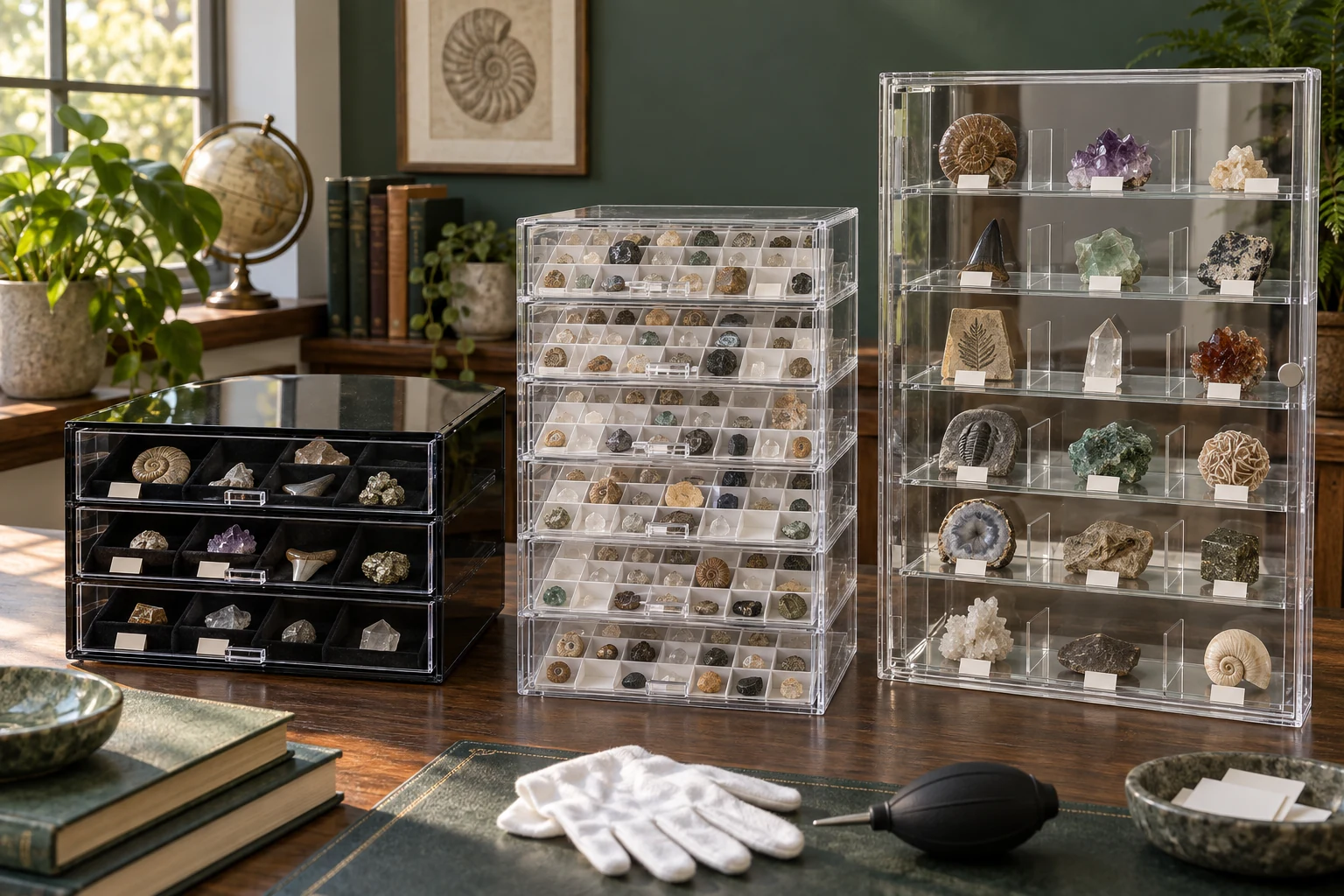
Dmnnlp's 54-grid drawers are the compact starter choice, KIYTARBOO doubles down on organised capacity, and Fhmidic's adjustable upright cabinet is better for a smaller selection of show pieces.
Quick answer
Which display case should you buy?
Compartment drawers suit many thumbnail specimens and keep labels associated with each piece. An upright cabinet sacrifices count for visibility and adjustable height. Measure your largest specimen, not your average one, before choosing.
- 01
Choose Dmnnlp for up to 54 small pieces in a compact 9.25 × 5.7 × 4.3-inch footprint, with dividers that can be removed for a few larger finds.
- 02
Choose KIYTARBOO when 90 fixed-size positions across five drawers suit a growing thumbnail collection better than open shelves.
- 03
Choose Fhmidic for up to 30 adjustable cells, larger 5.1 × 5 × 6 cm slots and front-facing display on a desk or properly supported wall.
The picks
The three display cases
All three are consumer acrylic organisers, not conservation-grade sealed cabinets. Their strongest benefits are physical separation, visibility and dust reduction.
Dmnnlp 3-Drawer 54-Grid Rock Display Case
Best for: Up to 54 thumbnail fossils, crystals or minerals where removable dividers add flexibility
The three-drawer footprint is small enough for a desk or shelf, while removable dividers let a few cells expand for irregular specimens. The black lining gives small pale pieces useful contrast.
- 54 cells in a compact footprint
- Removable dividers accommodate some larger pieces
- High-contrast velvet lining and clear viewing
- Only 47 ratings and no independent maker documentation
- Small cells exclude many hand specimens
KIYTARBOO 5-Drawer 90-Grid Rock Display Case
Best for: A growing thumbnail collection that benefits from 90 individually separated positions
For only £3 more than Dmnnlp, KIYTARBOO adds two drawers and 36 cells. Its stronger owner sample and exact compartment dimensions make it the practical high-capacity choice when specimens are consistently small.
- 90 compartments across five drawers
- Excellent checked capacity for £17.99
- Clear acrylic and velvet lining aid viewing and separation
- Fixed-size cells are unsuitable for larger or branching specimens
- No published conservation or loaded-weight specification
Fhmidic 6-Tier Adjustable Acrylic Rock Display Case
Best for: A curated set of up to 30 larger show pieces that should face forward on a desk or supported wall
The adjustable cells, 6 cm nominal slot height, mirrored back and front door prioritise visibility over dense storage. Desktop or wall placement also gives more room-planning flexibility than a stack of shallow drawers.
- Adjustable dividers suit mixed specimen widths
- Mirrored back and upright orientation improve display
- Magnetic front door gives easier access than stacked drawers
- Very small owner-feedback base
- Higher price for only 30 positions
- Included fixing suitability and load capacity are not stated
Collection care
Display is not preservation
A closed consumer case reduces handling and dust, but it does not automatically control light, humidity, pollutants or unstable specimen chemistry.
Dust
Doors, lids and drawers are easier to clean than delicate crystal faces, but none of these listings provides an independently tested particulate seal.
Light
Keep cases out of direct sun and strong UV. Light damage is cumulative and irreversible for sensitive labels, organic material and some coloured minerals.
Humidity and pyrite
Pyritised fossils and unstable sulphides can decay when exposed to unsuitable humidity and fluctuations. A decorative acrylic case is not a controlled microclimate.
Labels
Give every specimen a stable catalogue number and keep the full locality and acquisition record separately. Capacity is wasted if the collection becomes anonymous.
How we chose
How we chose
We required a clean exact Amazon UK page, transparent viewing, a closed front or drawer format, stated exterior and compartment dimensions, and a useful distinction in capacity. The two drawer cases solve dense thumbnail organisation; the upright Fhmidic solves display of fewer, taller specimens. Current owner volume was used only to flag obvious fit or assembly patterns, not as conservation evidence.
The brands do not publish meaningful technical or conservation documentation outside their retailer pages, so the verdicts deliberately stop at physical organisation and dust reduction. Open shelves, cases without dimensions and novelty containers were excluded. None is recommended for radioactive, toxic, actively decaying, liquid-preserved or otherwise hazardous specimens; those require specialist advice and appropriate storage.
Safety
Set up the case safely
Rock collections become heavy quickly, and small specimens can be hazardous even when the case looks domestic.
- Keep heavy specimens low and within the stated compartment size. Do not overload drawers or place a top-heavy case where children, pets or vibration can tip it.
- For wall mounting, check wall construction and use fixings rated for the total loaded mass; the included screws may not suit your wall.
- Use inert supports and reversible museum putty sparingly. Avoid unknown foams, adhesives and fresh wood products around sensitive specimens.
- Do not wash, air-blast or brush a specimen until you know its mineralogy and stability. Fragile crystals, soluble salts and pyritised fossils need tailored care.
- Seek specialist guidance before displaying radioactive minerals, asbestos-form minerals, mercury compounds or arsenic-bearing material in the home.
Sources
Sources and checking notes
Museum guidance defines the preservation limits; collector communities reveal practical dust and labelling concerns; Amazon pages establish dimensions, capacity and current UK prices.
-
01
National Park Service · Museum storage cabinets
Conservation guidance on protection from dust, light, pollutants, pests and environmental fluctuation, plus cabinet-size limits.
Open source -
02
National Park Service · Curatorial care of paleontological and geological collections
Professional reference on geological-collection storage, pyrite decay and the effect of temperature and humidity fluctuations.
Open source -
03
Natural History Museum / NatSCA · Project Airless
Museum case study explaining pyrite oxidation risk above 60% relative humidity and controlled-storage work.
Open source -
04
Library of Congress · Limiting light damage
Authoritative guidance that light damage is cumulative and irreversible and display environments should be monitored.
Open source -
05
Western Australian Museum · Preventive conservation overview
Museum guidance on stable temperature and humidity, lighting and suitable display and storage materials.
Open source -
06
r/Minerals · Keeping displays dust-free
Current collector discussion favouring closed cases while warning that cleaning methods depend on the specimen.
Open source -
07
r/rockhounds · Display boxes versus open storage
Large owner discussion on dust, portability, labels and individual versus cabinet display.
Open source -
08
Amazon UK · Dmnnlp 54-grid case
Exact ASIN checked live for price, exterior size, three drawers, 54 removable-divided cells and velvet lining.
Open source -
09
Amazon UK · KIYTARBOO 90-grid case
Exact ASIN checked live for price, five drawers, 90 cells, compartment dimensions and velvet lining.
Open source -
10
Amazon UK · Fhmidic 6-tier case
Exact ASIN checked live for price, 30 adjustable cells, dimensions, mirrored back, magnetic door and mounting options.
Open source
Guide information and links checked 15 September 2026.