Buying guide · Specialist & niche
The best gemstone testing kits for beginners
Collect clues, not verdicts.
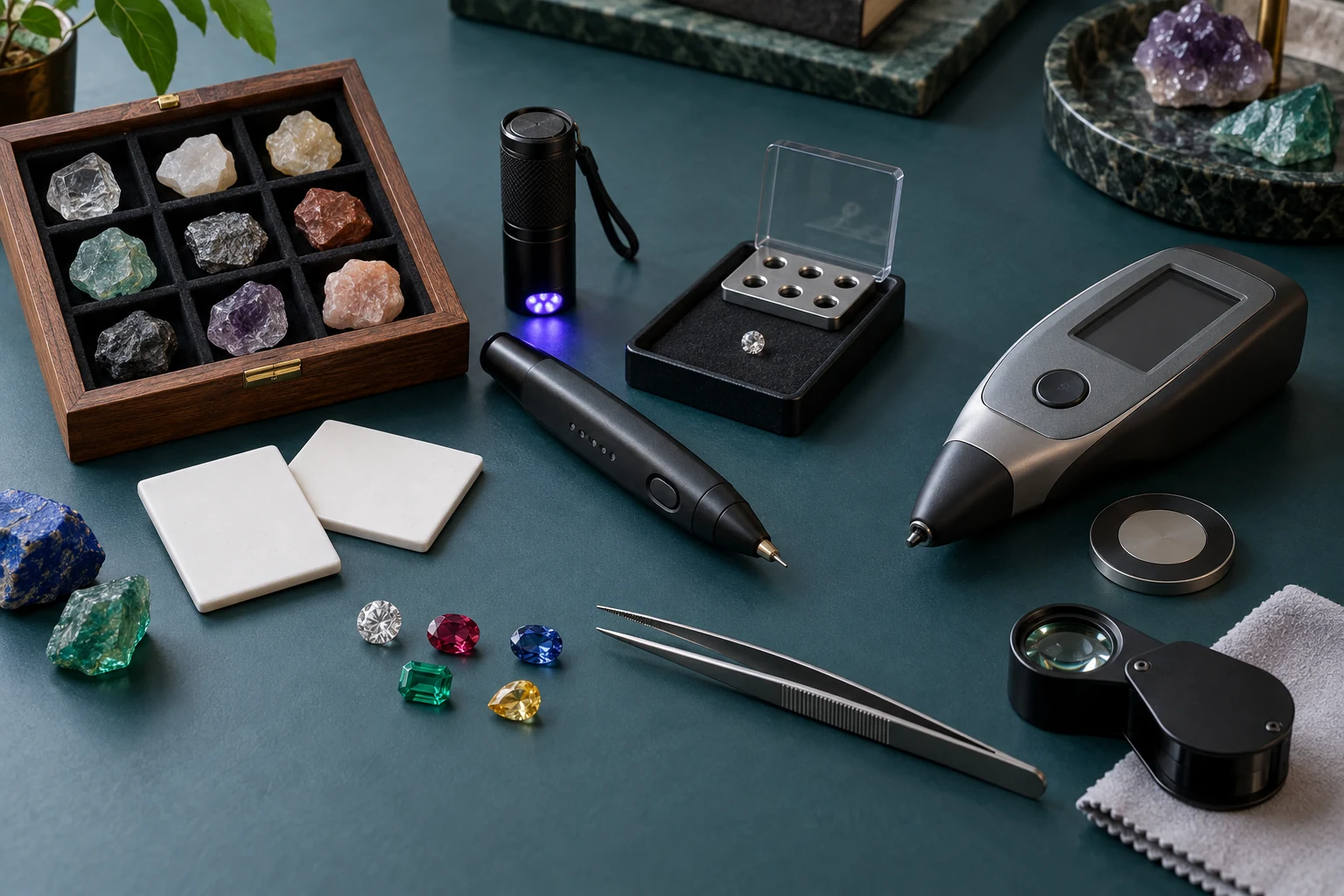
Landical's Mohs set is a low-cost learning kit for sacrificial rough, GAIN EXPRESS adds quick diamond screening, and Presidium's Gem Indicator is the serious colour-assisted option. None authenticates a valuable stone by itself.
Quick answer
What should a beginner buy?
Buy for the property you want to observe. A Mohs set teaches relative hardness and streak on disposable rough; a diamond pen screens thermal behaviour; the Presidium combines thermal response with a colour input to suggest possible groups. No single result proves identity, natural origin or treatment.
- 01
Use the Landical kit on known reference pieces and low-value rough only. Never scratch a cut stone, mounted jewel or specimen you want to preserve.
- 02
Use the GAIN EXPRESS pen only as a preliminary diamond-simulant screen, with the supplied loose-stone tray and correct calibration; ignore broad authenticity promises.
- 03
Choose the Presidium only if you will test many coloured stones and understand that its display shows possibilities based on thermal conductivity and colour, not a laboratory conclusion.
The picks
Three home-testing approaches
These are deliberately different tools. A useful beginner bench adds a 10× achromatic loupe, tweezers, neutral daylight, accurate weight and dimensions, reference tables and a written observation log.
Landical Earth Science Mohs Hardness Kit
Best for: Learning relative hardness and streak on disposable rough samples, not finished gemstones
The set turns the Mohs scale into a hands-on comparison using named reference minerals and two streak plates. It teaches observation and bracketing for less than £20, without pretending to output an identity.
- Nine named reference minerals cover Mohs 1 through 9
- Two streak plates add a second observable property
- Useful educational format at a low price
- Destructive on the tested material
- Reference-sample purity and calibration are not independently certified
- Does not include diamond/Mohs 10
GAIN EXPRESS Diamond Tester Pen with UV Light
Best for: Preliminary sorting of loose, near-colourless stones before confirmation by a trained professional
GAIN EXPRESS packages the probe with a proper loose-stone tray, manual, pouch and UV source. That makes it more usable than a bare bargain pen, but its useful question remains narrow: how the stone behaves under thermal and fluorescence screening.
- Includes a loose-stone platform, pouch and manual
- Audible metal-contact warning helps catch one common error
- Integrated UV light adds a separate observation
- Low 3.9-star owner average for a £56 tool
- Thermal and UV responses cannot authenticate or identify most gemstones
Presidium Gem Indicator PGI
Best for: Committed collectors testing many loose coloured stones who will learn calibration and confirm every result independently
Presidium is the only maker here with a detailed current product page and handbook. The colour input makes thermal groupings more useful than a bare pen, and the screen presents possible matches across 31 types rather than a single sweeping yes/no claim.
- Manufacturer-documented 31-type, 12-colour workflow
- Digital screen and calibration process are clearer than analogue pen lights
- Replaceable probe and updateable firmware ecosystem
- Very expensive for a beginner
- Thermal-plus-colour grouping cannot determine treatment or natural versus synthetic origin
- Limited Amazon stock and only middling owner-rating evidence
Limits
What each result really means
Identification is an elimination process. Treat every home result as one line of evidence and look for agreement across independent properties.
Hardness
A Mohs result brackets scratch resistance; it does not prove a species, and the test itself removes material or can open a fracture.
Thermal response
A pen compares how quickly a stone draws heat from a probe. Materials can overlap, and contact angle, stone size, temperature, setting metal and calibration can change the reading.
Colour-assisted thermal groups
Presidium narrows candidates using thermal response plus a chosen colour, but the maker's own manual presents possible types. It cannot establish natural versus laboratory-grown origin or disclose treatments.
How we chose
How we chose
We rejected the premise that one inexpensive gadget can authenticate gemstones. Gem-A recommends confirming findings with second and third tests, while GIA describes a professional workflow using refractometry, polariscopes, spectroscopy, specific gravity, microscopy and advanced laboratory methods. The shortlist therefore represents three honest levels of investigation: learning physical-property comparisons, quick diamond screening, and a better-documented assisted shortlist for coloured stones.
Exact Amazon UK pages, current prices and included accessories were required. A number of generic RHG181 refractometers were considered, but their live pages contained contradictory claims, unclear makers or very small owner samples; they were excluded despite refractive index being a valuable gemmological test. Cheap pens claiming to measure gemstone hardness electronically were also excluded because thermal conductivity is not Mohs hardness.
Safety
Protect the stone and yourself
The most serious beginner error is damaging a good stone in pursuit of a bad answer.
- Never scratch-test a faceted, polished, mounted, valuable or sentimental stone. Even rough can contain unseen fractures; test only a disposable protrusion and wear eye protection.
- Test loose stones on a proper tray. Keep powered probes off metal, follow calibration and temperature instructions, and do not press hard enough to chip a facet or bend the probe.
- Do not expose eyes or skin to UV longer than necessary. Never stare into a UV source, and keep it away from children.
- For any purchase, sale, insurance, treatment or natural-origin decision, use an independent qualified gemmologist or recognised laboratory report.
Sources
Sources and checking notes
Professional gemmology sources define what the tests can and cannot establish; manufacturer documents define the Presidium workflow; Amazon pages establish the exact UK offers.
-
01
Gem-A · The ideal gemmologist's toolkit
Professional guidance on loupes, refractometers, thermal testers and confirming findings with multiple tests.
Open source -
02
GIA · Analysis of gemstones at GIA laboratories
Professional laboratory workflow covering standard optical tests, specific gravity and advanced analysis for treatment and origin questions.
Open source -
03
GIA · Why scratching glass is not identification
Authoritative warning that many colourless minerals scratch glass and further gemmological testing is required.
Open source -
04
International Gem Society · Scratch testing
Professional explanation of Mohs testing as destructive and warning never to scratch-test a finished stone.
Open source -
05
Presidium · Gem Indicator
Manufacturer specifications for 31 possible gemstone types, 12-colour input and the thermal-conductivity probe.
Open source -
06
Presidium · Gem Indicator user handbook
Manufacturer instructions showing calibration, colour input and that the result is a set of possible gemstone types.
Open source -
07
r/Gemstones · Beginner tester discussion
Current community and professional-practitioner discussion warning against single-tool certainty and recommending a multi-instrument workflow.
Open source -
08
Amazon UK · Landical Mohs kit
Exact ASIN checked live for price, availability, nine reference minerals and two streak plates.
Open source -
09
Amazon UK · GAIN EXPRESS diamond tester
Exact ASIN checked live for price, availability, thermal probe, UV light, loose-stone tray, pouch and manual.
Open source -
10
Amazon UK · Presidium Gem Indicator
Exact ASIN checked live for price, limited stock and the PGI model designation.
Open source
Guide information and links checked 15 September 2026.