Buying guide · Models & RC
The best sprue cutters for plastic model kits
Separate rough cuts from finish cuts.
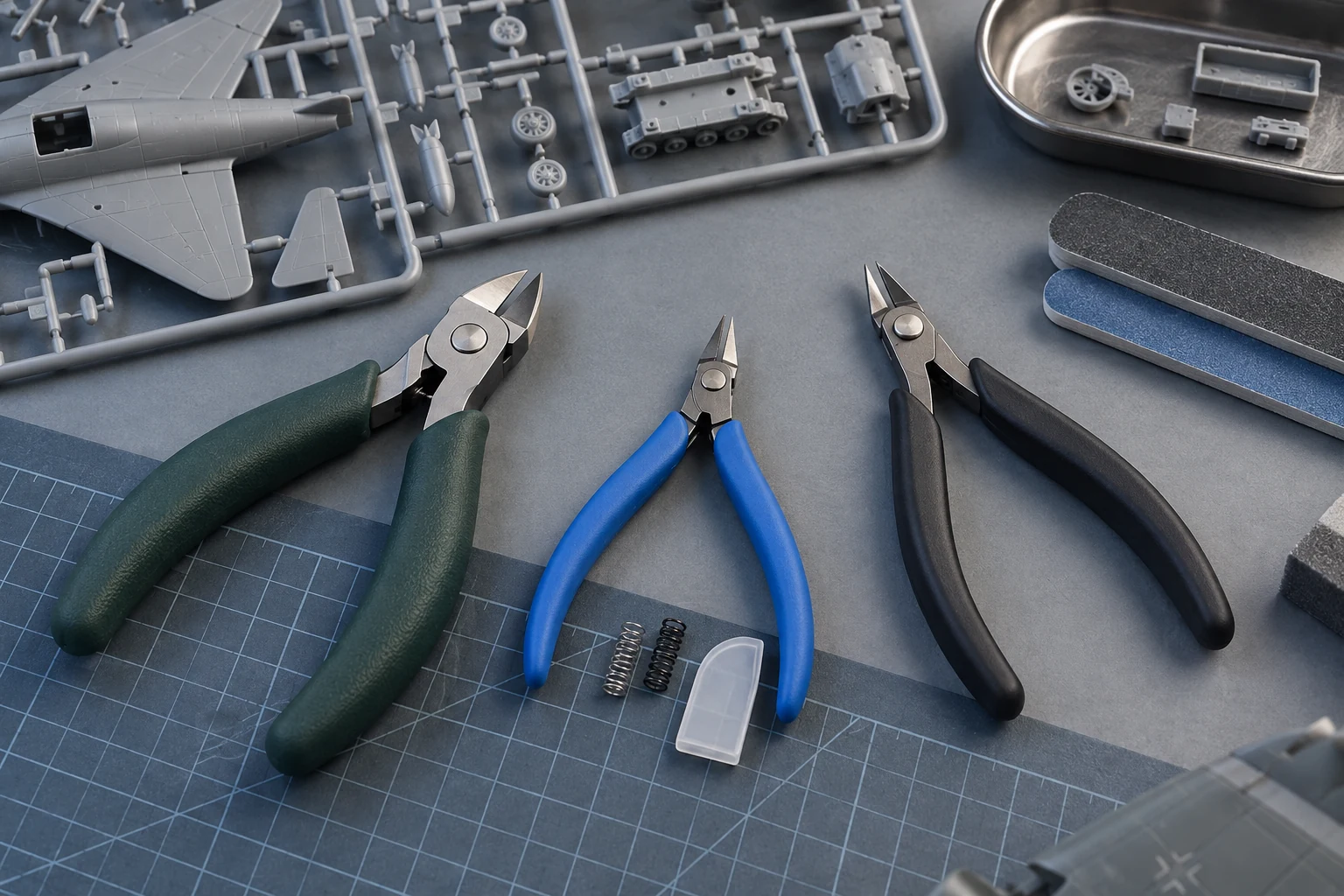
The Army Painter is the sensible first double-blade cutter, stedi's MS-104 is the value single-edge finishing upgrade, and Tamiya's 74123 earns its premium with unusually slim jaws and strong long-term evidence.
Quick answer
Which sprue cutter should you buy?
A double-blade cutter is forgiving for first cuts away from the part. A fine single-edge nipper slices a remaining nub with less whitening, but its blade is more fragile and demands a two-cut technique.
- 01
Choose The Army Painter for a low-cost first tool that can remove ordinary miniatures and model parts from soft plastic frames.
- 02
Choose stedi MS-104 as a second-cut tool for gates under the maker's stated 3 mm limit; keep a robust cutter for the first cut and thick runner.
- 03
Choose Tamiya 74123 if narrow access around delicate scale parts matters more than the absolute flattest single-edge finish.
The picks
The three sprue cutters
All three are for plastic model work. Use a sacrificial heavy cutter or fine saw for thick runner sections, then a hobby knife, file or sanding stick for the final surface where needed.
The Army Painter Plastic Frame Cutter
Best for: First kits, miniatures and general soft-styrene frame removal on a modest budget
The Army Painter provides the right basic geometry, comfortable broad grips and a strong current owner sample for £11. It is robust enough for first cuts without the technique and fragility penalty of a single-edge finishing nipper.
- Low price from an identifiable modelling-tool maker
- Broad anti-slip grips and return spring suit beginners
- Large current owner-feedback base
- Double blades can pinch and whiten plastic more than a fine single edge
- No stated maximum plastic thickness
stedi 4.7-inch Single-Edge Model Nipper
Best for: Second cuts on ordinary plastic gates under 3 mm where a flatter, lower-stress finish saves cleanup
stedi offers the defining single-edge advantage for £19: one keen blade slices toward an anvil rather than two wedges crushing the gate. The two springs and case make it a complete, well-supported step up from an entry cutter.
- Single-edge geometry reduces pinching and whitening
- Explicit under-3 mm plastic limit
- Two replaceable springs and blade case included
- Strong current owner sample for the price
- More fragile and technique-sensitive than a double-blade cutter
- Still needs a robust first-cut tool for thick frames
Tamiya Sharp Pointed Side Cutter for Plastic
Best for: Delicate scale kits with crowded sprues and narrow gates where access is the hardest part
Tamiya's 115 mm 74123 uses exceptionally slim pointed double jaws to reach gates that broad cutters cannot approach squarely. Its maker documentation and roughly 5,300 current ratings give the most mature evidence base in the guide.
- Very slim pointed jaws reach low-clearance gates
- 115 mm body and non-slip grips support fine control
- Excellent current owner average across a very large sample
- Clear manufacturer documentation
- Highest checked price
- Double-edge action can still compress the gate
- Fine tips remain vulnerable to hard or thick material
Technique
One cut is rarely the best cut
Leaving a small gate stub on the first cut reduces stress transmitted into the part. The finishing tool then has room to approach from a flat, supported angle.
First cut
Use the robust cutter on the gate away from the part. Support tiny pieces so they do not launch or bend when the gate releases.
Second cut
Use a sharp slim or single-edge cutter to reduce the remaining nub in small bites. Keep the flat anvil face against the side you want to preserve.
Finish
Stop before the blade digs into a curved surface. A sharp hobby knife, fine file or graduated sanding system is safer for the final trace.
Clear and hard plastic
Clear runners and some engineering plastics are more brittle or harder than ordinary styrene. Follow the cutter maker's limits and use a tougher sacrificial tool.
How we chose
How we chose
We required a clean exact Amazon UK page, an identifiable maker and model, jaws designed specifically for plastic model sprues, and current stock at a meaningful price step. Maker pages established the Army Painter's thin double blades, stedi's single-edge geometry and 3 mm plastic limit, and Tamiya's 115 mm slim-jaw specification. Airfix and model-making references confirmed that a cutter is a basic kit tool; community evidence was used for recurring cut-quality and fragility patterns.
The shortlist deliberately contains two double-blade tools and one single-edge tool because they solve different steps. Generic electrical flush cutters were excluded because jaw angle and hardness are not optimised for model gates. GodHand SPN-120 and DSPIAE ST-A 3.0 were considered, but no reliable exact live Amazon UK offer was confirmed. Cutter bundles were excluded because they obscure the quality of the one tool that matters here.
Safety
Protect the blade, part and eyes
Fine modelling jaws are cutting edges, not miniature pliers. Side loads and hard materials can chip them without warning.
- Wear eye protection, point the cut away from people and support small parts so clipped plastic cannot fly.
- Never use these cutters on wire, photo-etched metal, pins, staples or sheet metal. Keep a separately marked wire cutter for metal work.
- Do not twist the jaws, pry with the tips or cut beyond the stated gate thickness. Make several accessible cuts through the surrounding runner instead.
- Store fine jaws closed in their cap or case, keep the pivot clean and follow the maker's adjustment and lubrication instructions.
- If an edge chips, bends, overlaps or no longer meets squarely, stop using it; a damaged fine blade can fail or scar parts.
Sources
Sources and checking notes
Maker specifications establish geometry and limits; specialist and community sources supply workflow and durability context; Amazon pages establish exact current UK offers.
-
01
The Hobby Library · Model Aircraft Building
Beginner project context for preparing and assembling plastic model parts.
Open source -
02
The Army Painter · Plastic Frame Cutter
Manufacturer specifications for thin stainless blades, ergonomic anti-slip grip and plastic-sprue use.
Open source -
03
stedi · MS-104 single-edge pliers
Manufacturer page for the MS-104 single-edge geometry, model use and care context.
Open source -
04
Tamiya · Sharp Pointed Side Cutter 74123
Manufacturer specification for the 115 mm cutter, slim pointed jaws, non-slip grip and plastic-sprue purpose.
Open source -
05
Airfix · Essential tools for modelling
Established kit-maker guidance placing side cutters among the core tools for removing plastic parts.
Open source -
06
r/modelmakers · Are better sprue cutters worth it?
Current high-engagement comparison of budget, Tamiya and single-edge cutters, including clean-cut benefits and material limits.
Open source -
07
r/Miniaturespainting · Advice on new sprue cutters
Current community discussion of Tamiya, stedi and single-edge fragility, with recurring two-cutter workflows.
Open source -
08
Amazon UK · The Army Painter Plastic Frame Cutter
Exact ASIN checked live for price, availability, stainless construction, grip and current owner context.
Open source -
09
Amazon UK · stedi MS-104
Exact ASIN checked live for price, availability, single-edge blade, springs, grip and stated sub-3 mm plastic limit.
Open source -
10
Amazon UK · Tamiya 74123
Exact ASIN checked live for price, availability, 115 mm length, slim jaws and large current owner sample.
Open source
Guide information and links checked 15 September 2026.