Research-led buying guide · Tech & audio
Best power banks for emergency phone charging
Choose emergency phone power by usable energy, cables and recharge speed. Compare compact, larger-capacity and lightweight weather-resistant power banks.
Quick answer
Best power banks for emergency phone charging: the quick answer
The best power banks for emergency phone charging are the ones you keep charged with the right cable. The Anker A1388 is a reasonable one-person reserve. The A1383 adds twice the nominal capacity and fast recharging for a shared household. The Nitecore NB10000 Gen4 earns its premium mainly in a bag carried away from home.
- 01
For one phone, a 10000mAh wired bank normally gives a useful reserve without buying laptop-level output.
- 02
For two people or repeated top-ups, prioritise 20000mAh capacity. The A1383’s extra wattage is mainly useful when refilling it quickly between outages.
- 03
Choose the Nitecore for low weight and its documented water rating. It stores roughly half the energy of the larger Anker, despite costing more.
The picks
The researched shortlist
These are exact Amazon UK source listings. Prices and stock were checked on 29 October 2026 and vary by seller, delivery address and country. Any offer at purchase takes precedence.
Anker Power Bank 10K 22.5W with USB-C lanyard cable
Best for: One person needing a wired top-up source with replaceable cables
It covers the useful basics at a lower checked price than the other picks: wired USB-C charging, a second USB-A output and a readable percentage display. Anker specifies 20W input and 15W total when outputs are shared. A single compatible phone can negotiate faster charging, but the 22.5W headline is not a universal rate. Use it for topping up one phone rather than planning simultaneous fast charging for a family.
- USB-C input/output and USB-A cover common wired devices
- Removable cable can be replaced if lost or damaged
- Percentage display makes routine charge checks easy
- Shared output falls to 15W total
- No published water rating in the checked documentation
- We have no exact-model laboratory capacity result
Anker Power Bank 20K 87W with built-in USB-C cable, black
Best for: Two phones or several partial charges during a longer interruption
For roughly £11 more than the A1388 at this check, it doubles nominal cell capacity and adds a cable you cannot forget. TechRadar found useful charging performance but considered the high wattage excessive for many phones. Here the attraction is energy reserve and refilling speed: Anker claims a 1.5-hour refill with a suitable 65W source. A low-power wall plug will take longer, and the plug is not included.
- Twice the nominal capacity of the 10K choices
- 65W input can refill quickly when mains power returns
- Built-in USB-C cable plus separate ports provide flexibility
- Substantial size and weight; several owners mention this
- Fastest refill requires a suitable charger and cable
- Percentage display is not a remaining-runtime guarantee
Nitecore NB10000 Gen4 power bank
Best for: A grab bag where low weight and documented water resistance matter
This is an expensive way to buy 10000mAh, but an effective way to reduce bag weight. The maker specifies about 143g and IPX7. CleverHiker’s Gen4 test found efficient delivery for its size and a roughly three-hour refill, but a 13% efficiency loss in its cold comparison. The two USB-C ports share only 15W when both are used. Buy it for portability, not as a larger family energy reserve.
- Very low weight for its nominal energy
- IPX7 rating adds a documented protection level for a carried bag
- Two USB-C ports and an included cable reduce cable clutter
- Nearly twice the larger Anker’s checked price for half the nominal capacity
- Cold testing showed a meaningful efficiency penalty
- Short cable and touch/knock controls may frustrate some users
How many phone charges should you plan for?
How many phone charges should you plan for?
Use watt-hours when possible. A 10000mAh bank is typically labelled around 37–39Wh; a 20000mAh bank around 74Wh. The advertised mAh usually refers to internal cells at their own voltage. The phone receives less energy after voltage conversion, cable loss and charging loss. Dividing the bank’s mAh directly by the phone’s mAh overstates the reserve.
As a conservative planning example, assume 60–75% of nominal bank energy ends up stored in a 17Wh phone battery. That gives roughly 1.3–1.7 full-equivalent charges from 38.5Wh, or 2.6–3.3 from 74Wh. This is our illustrative calculation, not a product test or guarantee. An older battery, screen use, temperature and charging protocol change the result. Test your actual phone and cable before depending on them.
Partial top-ups are practical. Lower screen brightness and use the phone’s power-saving settings. A three-day kit does not require leaving a phone tethered continuously. Network service can still fail even with a charged battery.
Plan the recharge and keep the cable usable
Plan the recharge and keep the cable usable
An output rating says how fast a compatible device might receive power; an input rating says how quickly you can refill the bank. Both need a suitable cable and power supply. The A1388 accepts up to 20W; the A1383 up to 65W; the NB10000 Gen4 up to 22.5W. Actual charging tapers near full.
The A1384 20K/30W was considered, but the checked generic-titled marketplace offer was more expensive and less clearly identified than the A1383. Magnetic wireless banks waste more of the reserve as heat and require phone compatibility, so wired models take priority here. Tiny solar panels and hand-crank radios are not substitutes for a charged phone bank. A large portable power station is unnecessary if charging phones is the only job.
For household redundancy, two modest banks with two tested cables may be more useful than one expensive unit. This is a practical risk-spreading choice, not a claim that any particular model will fail.
Keep stored power ready
Keep stored power ready
The government’s current checklist includes a charged power bank. Check the exact model and any recall notices before putting an existing bank into emergency storage.
- Inspect and test stored banks regularly. Follow the maker’s storage and top-up interval; check again before forecast disruption.
- Stop using a swollen, damaged, leaking or unusually hot bank. Keep charging on a dry, uncovered surface with a compatible supply.
- Follow the manufacturer’s recall instructions for an affected unit, including disposal; do not put recalled lithium batteries in household waste.
- Ordinary phone banks are not automatically suitable for medical equipment, mains appliances or uninterrupted power. Check the device supplier’s requirements.
How we chose
How we chose
This is desk research, with no hands-on testing by The Consumer Library. Manufacturer documentation anchors specifications; named independent reviewers supply their own observations. Owner comments help identify recurring usability issues, but cannot establish failure rates or certify performance. Retailer ratings can combine colours, revisions and older products. We compared the alternatives discussed in this guide and selected products for a specific job at their checked prices.
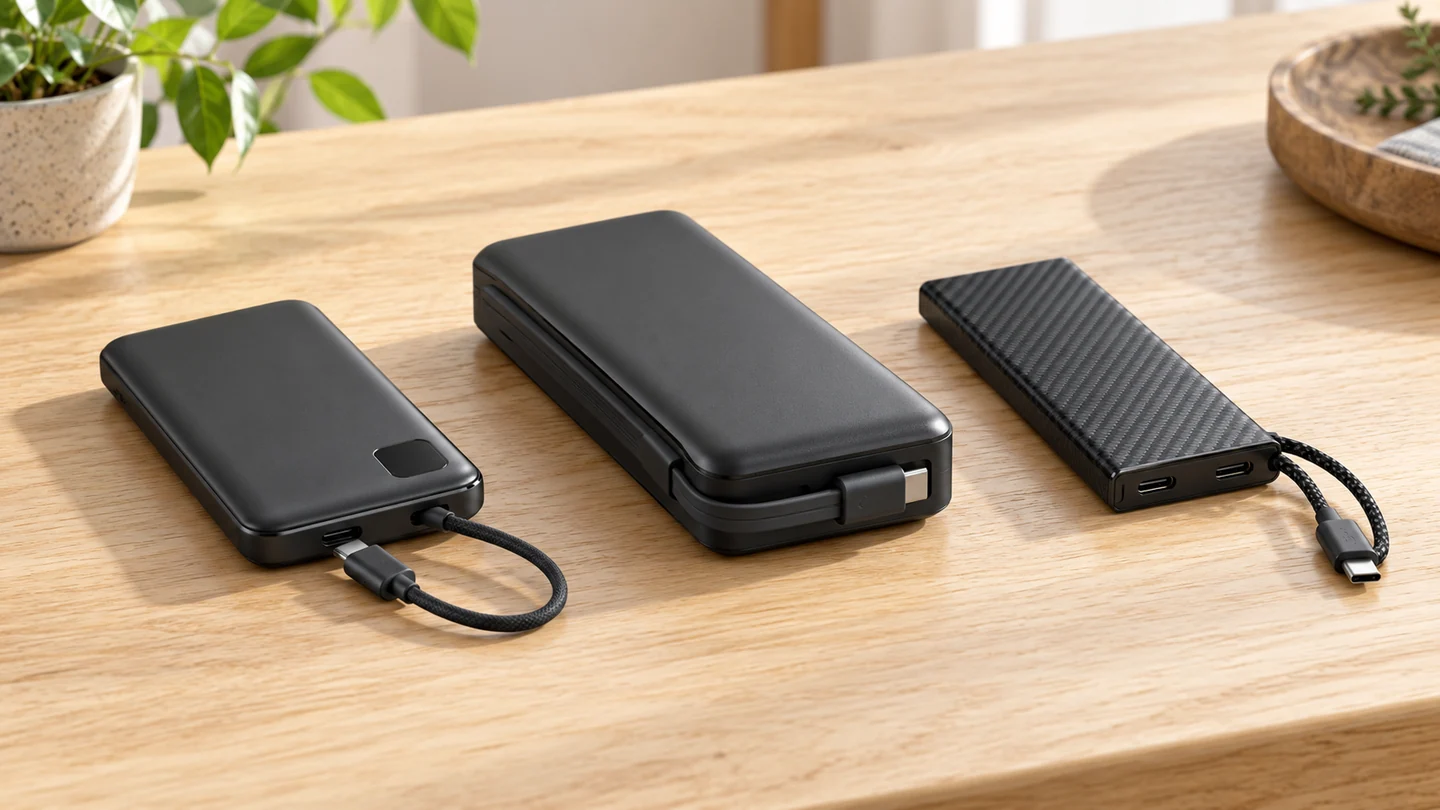
The hero is an AI-generated illustration of representative shortlisted product types, not a photograph of review samples. Browse [Tech & audio](/category/tech-audio) for related buying questions.
Sources
Sources and checking notes
All pages below were checked on 29 October 2026. Publication dates, where available, are included in the notes; an undated page has a checked date, not an invented publication date. Retailer stock is a snapshot.
-
01
Be Ready — household checklist
Current guidance includes a charged bank and gradual household preparedness. Checked 29 Oct 2026.
Open source -
02
Anker — A1388 user guide
Exact A1388 guide: 20W input, USB-C/USB-A, 15W shared output and trickle mode. 22.5W is not a universal PD charging rate.
Open source -
03
Anker — A1383 technical support
Exact A1383: 20000mAh, 65W single USB-C path and input, 87W combined rating. Current technical page.
Open source -
04
Nitecore — NB10000 Gen4
Current Gen4 energy, weight, input, shared output and IPX7 figures. Gen3 is a different product.
Open source -
05
TechRadar — Anker 20K 87W review
30 May 2025, Lewis Maddison. Actual Pixel 7a charge, cable handling and bulk; percentage loss is not a complete energy-efficiency test.
Open source -
06
CleverHiker — NB10000 Gen4 test
10 Apr 2026. Measured refill and comparative cold-efficiency result; outdoor sample does not establish long-term failure prevalence.
Open source -
07
Pack Hacker — NB10000 Gen4 review
Updated 21 May 2026 after two weeks. Short cable and finicky mode controls complement the charging test evidence.
Open source -
08
Anker — global selected-model recall
Current notice names A1647, A1652, A1257, A1681 and A1689. Selected A1388/A1383 are not those models. Check the actual label/serial against current local notices; no blanket safety claim.
Open source -
09
Amazon UK — A1388 10K
Browser check: £28.49 new, in stock. Owners 14 July and 16 Sept 2026 describe useful reserve; comments are not controlled capacity tests.
Open source -
10
Amazon UK — A1383 20K 87W black
Browser check: £39.98 promotional new offer, in stock, AnkerDirect UK. Owner feedback 11 Mar and 28 May 2026 repeats bulk/weight concerns and convenient cable use.
Open source -
11
Amazon UK — NB10000 Gen4
Browser check: £73.28 new, one left. Exact fourth generation, two USB-C ports. Owner history is short; older-generation reliability reports not transferred.
Open source
Guide information and links checked 29 October 2026.