Research-led buying guide · Household preparedness
Best mini UPS battery backups for broadband routers
A small DC UPS can keep a compatible router running through a short cut. Voltage, connector fit, ONT power and the wider network determine whether it helps.
Quick answer
Best mini UPS battery backups for broadband routers: the short answer
For a matched 12V router, APC is the larger-reserve choice. Eaton is useful for 9V, 15V or 19V; Tecnoware is the budget option for a lighter compatible load.
- 01
Ask the broadband provider about supported or eligible backup before spending.
- 02
Check the ONT and digital-phone equipment as well as the router.
- 03
Use the APC only with a suitable 12V adapter and matching tips.
- 04
Test the whole setup; no mini UPS can guarantee the external broadband network stays up.
The picks
The researched shortlist
Three exact models, selected for different needs. Prices are snapshots of the Amazon UK source listings; country, seller, stock, delivery and promotions can change.
Tecnoware ERA PLUS DC USB-C, 25W
Best for: A 5V USB device or a correctly matched 12V router
The checked £31.70 price is attractive for a small device that fits the supplied outputs. USB-A can power a compatible 5V device; the included USB-C-to-barrel lead provides 12V for a suitable router. Its approximately 20Wh battery is meaningful for low-power equipment without the size of a mains UPS.
- Lowest checked purchase price
- USB-A and USB-C options for small devices
- Approximately 20Wh in a compact unit
- 25W total and 12V limited to about 2.08A
- Local mains connection may require an extra purchase
- Sparse independent tests of this exact USB-C edition
Eaton 3S Mini 36W, British-lead version
Best for: A router voltage the 12V-only APC cannot serve
The Eaton earns its place through voltage choice and an integrated mains supply. It can replace a compatible router adapter rather than adding a battery in line with it. Its four supplied barrel tips cover several common sizes, and the independent technical test gives more useful energy evidence than an unspecified 'up to' runtime.
- 9V, 12V, 15V and 19V options
- Built-in AC supply avoids relying on the old router adapter
- Independent load-specific usable-energy evidence
- About 16.3Wh: the smallest nominal reserve here
- Recurring long-term owner failure reports
- One output and connector-fit limitations
APC Back-UPS Connect 12V
Best for: A 12V device with a suitable existing power adapter
The APC has the largest nominal energy of these three. Its manufacturer also publishes runtime at specific loads: two hours at 9W or one hour at 20W are more useful planning references than 'up to four hours'. Inline installation can be tidy when both input and output tips fit and the existing adapter is suitable.
- Largest nominal capacity here at 27.75Wh
- Published load-specific runtime table
- Compact inline format with multiple pin adapters
- 12V only; no AC adapter included
- Slow 12-hour typical recharge
- Both sides of the inline connection must fit correctly
A working router does not guarantee working broadband
A working router does not guarantee working broadband
The best mini UPS battery backup for a broadband router is one that matches every device in your connection path. On full fibre, the wall-mounted optical network terminal (ONT) usually needs power as well as the router. Mesh nodes and a digital home-phone base may add further loads.
Even if those devices stay powered, the street cabinet, exchange, upstream network or provider equipment may be affected. Mobile coverage can also be disrupted. A mini UPS preserves a chance of connectivity; it cannot promise internet or emergency calls throughout an outage.
Before buying, ask the provider about its supported backup solution. Ofcom’s UK guidance says eligible customers dependent on a landline without a reliable alternative may qualify for free backup support lasting at least an hour. That is a UK eligibility arrangement, not a worldwide entitlement. Other countries and providers differ.
These products are consumer networking options, not validated telecare or medical continuity systems. Arrange those needs with the service provider. For other small electronics, visit Tech & audio.
Five checks before plugging anything in
Five checks before plugging anything in
Read the router/ONT label and existing adapter, not just the brand name.
- Voltage must match exactly. A 12V router is not a 9V or 19V device. Eaton offers four selected voltages; set and verify the correct one before connection. Tecnoware’s supplied barrel lead requests 12V, despite its USB-C port supporting other PD profiles.
- Available current must be sufficient. At 9V the Eaton allows 3A, or 27W; at 12V it allows 3A/36W, at 15V 2.4A and at 19V 1.89A. Tecnoware allows about 2.08A at 12V and 25W total. APC supplies up to 3A at 12V.
- Polarity must match. Check the centre-positive/negative symbol on the equipment and supplied lead. Do not reverse polarity or assume an adapter tip corrects it.
- Connector dimensions and depth must fit. Outer diameter, inner pin/hole and insertion depth all matter. Eaton’s tips are 3.5×1.35, 4.75×1.7, 5.5×2.1 and 5.5×2.5mm. Tecnoware includes 3.5×1.35, 4.8×1.7, 5.5×2.1 and 5.5×2.5mm. APC defaults to 5.5×2.5mm with extra 2.1mm and 1.7mm pin adapters. Check the full dimensions before assuming a match.
- The input supply must suit the UPS. Eaton has 100–240V AC input and the selected British mains lead; use an approved local lead elsewhere. Tecnoware specifies 110–240V, 50/60Hz, and an Italian lead: do not assume it is approved for a 100V region. APC instead takes 11.4–12.6V DC from a compatible existing adapter, with input up to 4.1A including charging.
An adapter rated for the router alone may lack spare current for APC battery recharge. Confirm the combined requirement with APC rather than buying an arbitrary higher-voltage supply. A USB-C PD profile is not the same thing as a passive USB-to-barrel wire.
Eaton and APC each have one device output. Four tips are alternatives, not four powered ports. Do not add a Y-splitter for router plus ONT unless the manufacturer approves the complete load, voltage and connector arrangement. None of these three is a general-purpose standard PoE injector.
How much time should you plan for?
How much time should you plan for?
Battery milliamp-hours only mean something alongside voltage. Tecnoware’s 5200mAh describes its approximately 3.7V cells, not 5200mAh delivered at 12V. Its nominal battery is about 20Wh; Eaton is about 16.3Wh and APC 27.75Wh.
Delivered energy is lower. TheBug’s independent Eaton test measured 11.8Wh at 6W/12V. Its particular Zyxel router averaged 7.6W and ran 1 hour 33 minutes. That is one documented configuration, not every router’s runtime.
For the Tecnoware, a purely illustrative 80% delivery assumption gives 20Wh × 0.8 ÷ 10W = 1.6 hours at a steady 10W. No controlled test of this exact edition was found to verify that assumption; do not plan around an unspecified four-hour marketing claim.
APC’s published table gives 2 hours at 9W, 1 hour at 20W and 30 minutes at 36W. Its four-hour headline applies to a 5W load. The table is a manufacturer estimate rather than our measurement.
Wi-Fi activity, attached USB devices, phone use, ageing, temperature and charge state change endurance. Measure or test the actual router and ONT together. Leave a reserve rather than treating the last minute as dependable. The APC’s typical 12-hour recharge also matters during repeated cuts.
Setup check
Check the complete setup before relying on it
A short planned test is more useful than discovering a mismatch during an outage.
- Charge fully as instructed, then disconnect incoming mains while checking that the router and ONT stay on. Test only when a temporary loss of connectivity is acceptable.
- Check internet access and, where applicable, the provider-supported calling arrangement. Lights on the router alone do not prove the wider network is available.
- Keep the unit dry, ventilated and within its temperature limits. Leave the status LEDs accessible rather than hiding it against a warm router.
- Repeat a runtime check periodically and after changing router, firmware, adapter or battery. Investigate swelling, abnormal heat or reduced endurance using the manufacturer’s service advice.
- Do not modify barrel tips, force connectors or replace lithium cells with unspecified loose batteries. Use supported repair or replacement routes.
Our method
How we chose and what remains uncertain
We selected three identifiable models with documented electrical limits, then checked their exact new Amazon UK offers on 29 October 2026. We have not installed or tested them. The Tecnoware, Eaton and APC prices were £31.70, £55.99 and £61.70, respectively.
The Eaton is a specialist voltage option rather than a premium runtime upgrade. The APC costs more than it at these prices because it offers a larger 12V-only reserve. A conventional AC UPS is an alternative for unusual adapters or multiple equipment supplies, but adds size, cost and conversion losses; a provider-supported kit can be simpler.
Independent repeatable evidence is strongest for the Eaton, limited for this exact Tecnoware, and supplemented by manufacturer runtime data for APC. Multiple Eaton owners report failures over time, but review samples cannot establish incidence or causes. APC owners repeatedly mention tip/adapter compatibility. Tecnoware’s merged reviews include unrelated large AC UPS models, so their ratings were excluded.
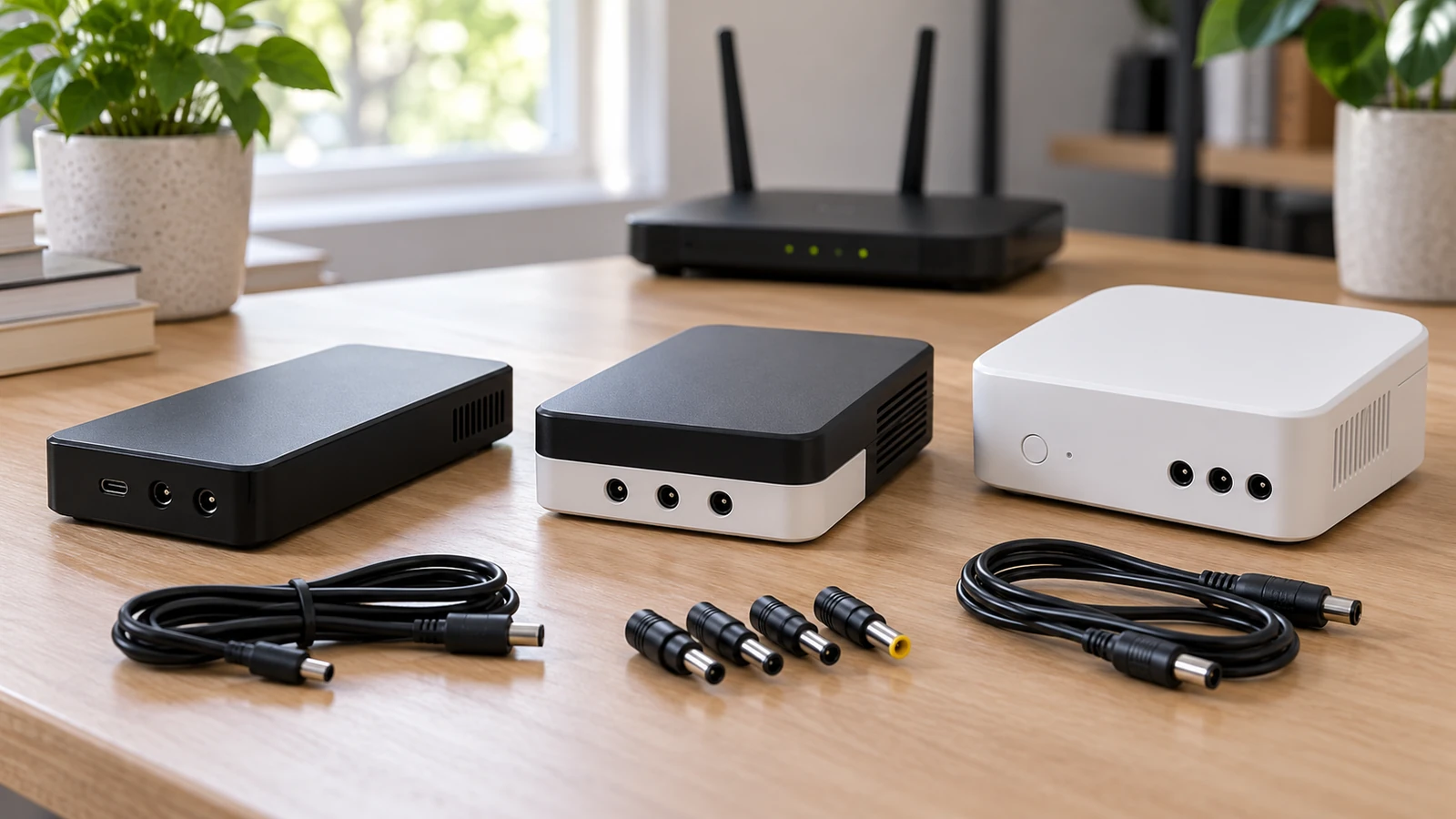
The AI-generated hero shows representative mini UPS enclosures and loose DC tips. It is not a wiring diagram or evidence of the exact number of outputs.
Sources
Sources and checks
Specifications, independent reporting and owner accounts are identified below. All pages were checked on 29 October 2026. Owner reports are anecdotes, not controlled tests; the notes identify model and edition limits.
-
01
Ofcom: stay connected in severe weather
Checked 29 October 2026. Current UK guidance on digital landlines, network disruption and provider support for eligible landline-dependent customers.
Open source -
02
BT: setting up battery backup
Checked 29 October 2026. Provider instructions show the need to power both hub and ONT on relevant fibre services. Provider support is equipment and eligibility specific.
Open source -
03
Tecnoware: ERA PLUS DC USB-C specification
Checked 29 October 2026. 2024 manufacturer sheet, FGCERAPLDC253C. 20Wh, 25W, supplied 12V lead, USB-PD profiles and Italian two-pin mains lead.
Open source -
04
Eaton: 3S Mini advanced user manual
Checked 29 October 2026. Voltage selection, connector dimensions, regional input and setup. Four tips serve one output; not four independently powered devices.
Open source -
05
APC: Back-UPS Connect technical brochure
Checked 29 October 2026. Schneider Electric 2023 brochure, dealer-hosted. CP12036LI input, 27.75Wh, connector pins and load-specific runtime table.
Open source -
06
APC: CP12036LI user manual download
Checked 29 October 2026. Manufacturer manual entry, version 1.1, 1 March 2023. Existing compatible 12V adapter is used; AC adapter is not supplied.
Open source -
07
TheBug: Eaton 3S Mini examination and measurements
Checked 29 October 2026. Independent technical community test: 11.8Wh delivered at 6W/12V; Zyxel router averaged 7.6W and ran 1h33. One sample, not every router.
Open source -
08
Amazon UK: Tecnoware USB-C edition and owners
Checked 29 October 2026. £31.70 new, in stock from Amazon. Exact MINI USB-C owner, 28 August 2026, confirms Italian plug; other UPS models are merged in reviews.
Open source -
09
Amazon UK: Eaton 3S Mini and long-term owners
Checked 29 October 2026. £55.99 new, in stock from Amazon. Multiple 2022–2026 owner accounts describe connector issues and failures after roughly 1–3 years; no failure-rate inference.
Open source -
10
Amazon UK: APC CP12036LI and owners
Checked 29 October 2026. £61.70 new, in stock. Owners dated 26 June and 30 December 2025, 10 June and 1 September 2026 recur on adapter/tip fit and useful short-cut backup.
Open source -
11
Feefo: Comms Express CP12036LI purchaser feedback
Checked 29 October 2026. Small separate 2026 purchaser sample supports compactness and short-outage use. Too few reports for a reliability estimate.
Open source
Guide information and links checked 29 October 2026.