Research-led buying guide · Tech & audio
Best battery-powered and wind-up emergency radios
Choose an emergency radio by local reception, spare power and simple controls. Compare AM/FM, DAB and wind-up options with realistic charging limits.
Quick answer
Best battery-powered and wind-up emergency radios: the quick answer
The best emergency radio is one that receives a useful local station where you will use it. Choose the Panasonic RF-2400D for a simple AM/FM receiver with replaceable AA cells, the Roberts Play 11 for local DAB/DAB+ and FM, or the XHDATA D-608WB if you specifically want a rechargeable radio with a crank and small solar panel. None is a two-way radio.
- 01
Tune a useful local station before buying extra features. FM, AM and DAB availability varies by country and transmitter coverage.
- 02
Keep spare AA cells for the Panasonic or Roberts. The Roberts USB-C socket powers the radio but does not charge its AA batteries.
- 03
Buy the XHDATA for its reception options and replaceable rechargeable battery. Charge it by USB before storage; no verified minutes-of-cranking to listening-time conversion was established.
The picks
The researched shortlist
These are exact Amazon UK source listings. Prices and stock were checked on 29 October 2026 and vary by seller, delivery address and country. Any offer at purchase takes precedence.
Panasonic RF-2400D portable AM/FM radio, black
Best for: A household wanting a large dial and ordinary replaceable batteries
This is the strongest straightforward choice if your useful stations broadcast on AM or FM. Four AA cells can be changed without a cable, and the large tuning scale and speaker suit shared listening. Panasonic rates alkaline LR6 operation at about 52 hours on FM or 55 on AM under its test conditions. These are listening estimates, not a volume-independent guarantee. RadioJayAllen found the D revision improved tuning precision over the original while remaining an ordinary portable rather than a specialist distant-station receiver.
- Large dial, carry handle and speaker make basic listening approachable
- Four AA cells give a simple spare-power plan
- AM adds a reception option missing from the Roberts
- No digital DAB reception or rechargeable battery included
- Large cabinet is less convenient in a small evacuation bag
- Retailer history combines older and current revisions
Roberts Play 11 DAB/DAB+/FM radio, black
Best for: A home with useful local DAB/DAB+ stations and tested reception
The premium over the Panasonic buys digital station selection and a smaller cabinet, rather than more radio bands or built-in charging. The independent Digital Radio Choice reviewer found useful DAB reception and straightforward controls, but modest sound at higher volumes. Four AA cells make it practical during a cut; USB-C lets you power it from a suitable external source. It offers ten DAB and ten FM presets. Save your stations while mains power is available.
- DAB/DAB+ station names and presets simplify regular local listening
- AA fallback and USB-C external power provide two supply routes
- Smaller than the large Panasonic cabinet
- No onboard AA charging despite the USB-C socket
- No verified battery-runtime figure for emergency planning
- Small speaker and weak local DAB coverage limit usefulness
XHDATA D-608WB rechargeable emergency radio, orange
Best for: An interested user prepared to learn its bands and maintain a charged cell
This adds more ways to receive broadcasts and replenish its replaceable battery. FM is the most straightforward role; mediumwave and shortwave offer additional possibilities where stations exist, but reception needs experimentation. The maker supports regional 9/10kHz AM steps. SWLing’s first-hand reviewer found useful FM reception but scan and tuning quirks. The crank can add energy when USB power is unavailable, yet there is no trustworthy fixed listening-time return per minute of winding in the checked evidence.
- Replaceable 18650 avoids dependence on a sealed ageing pack
- USB charging, crank and panel provide different energy routes
- FM, regional-step AM and shortwave broaden reception options
- Crank/solar output and useful-volume runtime lack solid quantified evidence
- Many controls and scan quirks need practice
- NOAA branding has little value outside its coverage area; keep the radio dry
Choose the broadcast before the radio
Choose the broadcast before the radio
Current official preparedness guidance includes a battery-powered or wind-up radio because phones and broadband can fail during a power cut. It does not mean every receiver will receive an emergency broadcast, or that transmitters cannot also lose power. Write down useful local frequencies and emergency information sources on paper. Listen occasionally to check what is actually broadcast where you live.
Extend and reposition the telescopic antenna for FM or DAB. Rotate the whole radio for AM, whose internal ferrite antenna responds to direction. Try a window away from LED lamps, chargers and computers that can cause interference. Switching off a noisy USB supply may improve reception. Shortwave reception depends on time, propagation, station schedules and interference; buying more bands does not guarantee more useful local information.
The Panasonic covers roughly 87–108MHz FM and regional-step AM; the Roberts adds DAB/DAB+ but loses AM. The XHDATA adds wider regional FM options, MW and shortwave. Check your country’s broadcast bands and tuning steps. None of these devices transmits a call for help.
What wind-up and solar can realistically do
What wind-up and solar can realistically do
The XHDATA’s charging hardware is real, but usable energy depends on crank speed, time, sun angle and battery state. An indicator lighting up is not a measured phone charge or proof of enough power to listen. We found no sound basis for promising a stated number of radio minutes from one minute of winding, or a full solar recharge in a day.
Blog or Die’s first-hand winter experiment found the panel could support the clock but not continuous radio or weather-alert operation. That result does not quantify summer yield; it does show why a tiny panel should not be the primary plan. The edited English manual describes solar as slow and cranking as a fallback requiring considerable time. Use a compatible USB supply, retain a charged cell and rehearse the fallback before an emergency.
The Panasonic’s alkaline runtime is documented; the Roberts and XHDATA do not have sufficiently supported useful-volume figures in the evidence we checked. For those, conduct a normal-day listening check and allow a spare-power margin. The Roberts can run from USB without charging its AA cells; the XHDATA charges its own cell. These are different arrangements.
Which extra features are worth paying for?
Which extra features are worth paying for?
Choose the Panasonic if AM/FM coverage and simple spare cells solve the job. Pay for the Roberts when local DAB stations matter. Choose the XHDATA only if you will learn its controls and maintain its rechargeable battery; its lower checked price than the Roberts is not evidence that it is the better general-purpose radio.
The Midland ER300 was considered but its checked Amazon listing was unavailable. Panasonic RF-D10 offers were also considered, but the displayed delivery window was unsuitable. A phone’s streaming app remains useful while networks and data power work, but it is not an independent broadcast receiver. A separate phone power bank is a more credible charging reserve than a radio’s small crank.
Keep the receiver ready
Keep the receiver ready
Store the radio with its instructions, frequencies and the correct spare power.
- Check reception and controls periodically, including battery operation with mains disconnected.
- Keep AA sets matched and inspect for leakage. For rechargeable lithium power use the specified compatible cell and protect spare cells from short circuits.
- Keep charging connections dry. Do not assume rugged-looking orange housings are waterproof.
- A siren or weather-band label does not guarantee local official alerts. Check the service and coverage in your country.
How we chose
How we chose
This is desk research, with no hands-on testing by The Consumer Library. Manufacturer documentation anchors specifications; named independent reviewers supply their own observations. Owner comments help identify recurring usability issues, but cannot establish failure rates or certify performance. Retailer ratings can combine colours, revisions and older products. We compared the alternatives discussed in this guide and selected products for a specific job at their checked prices.
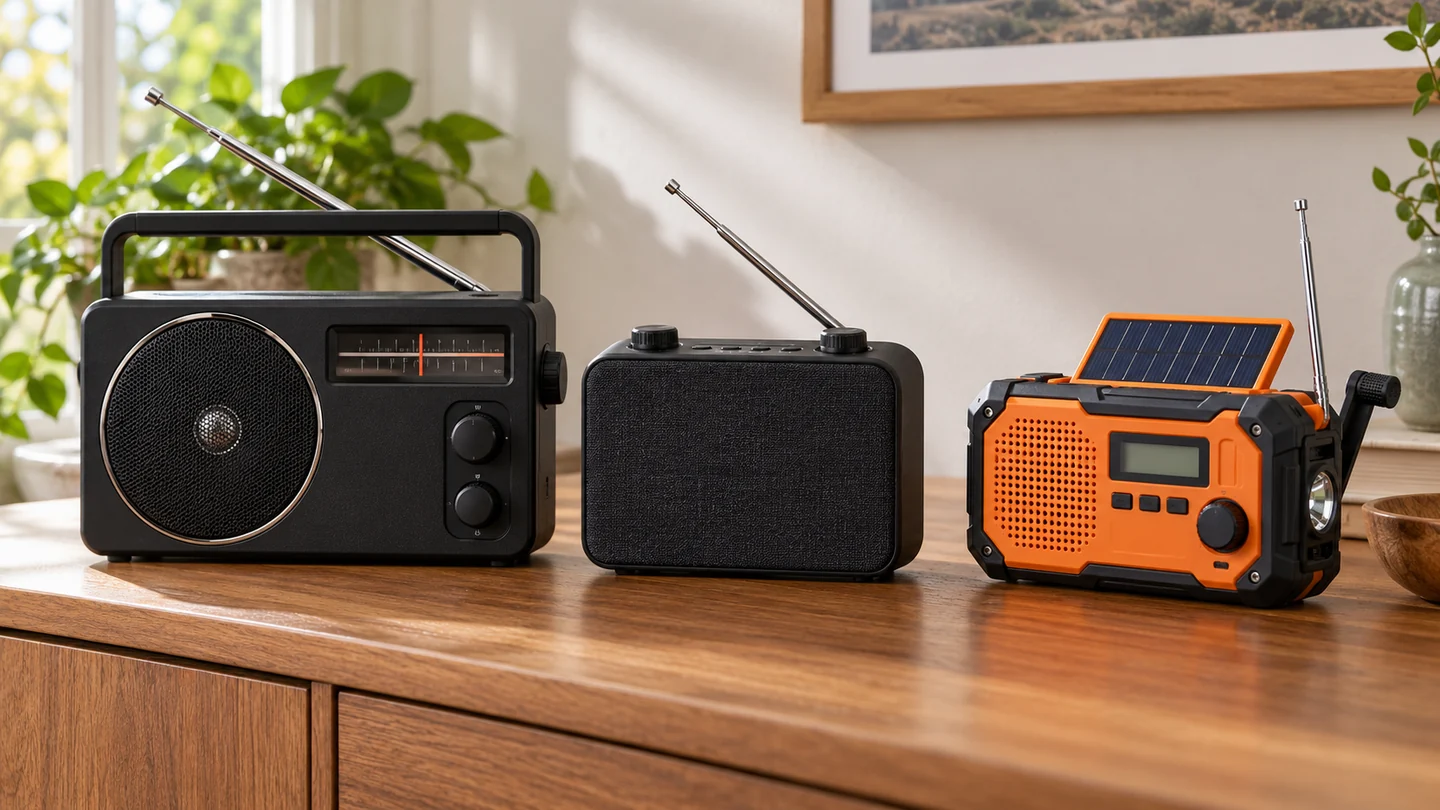
The hero is an AI-generated illustration of representative shortlisted product types, not a photograph of review samples. Browse [Tech & audio](/category/tech-audio) for related buying questions.
Sources
Sources and checking notes
All pages below were checked on 29 October 2026. Publication dates, where available, are included in the notes; an undated page has a checked date, not an invented publication date. Retailer stock is a snapshot.
-
01
Be Ready — phone and broadband outages
Current government advice includes independent information sources during communications failure. Checked 29 Oct 2026; national numbers are not presented as worldwide advice.
Open source -
02
Panasonic — RF-2400D specifications
Current D-model table: regional-step AM/FM, 4 AA, LR6 alkaline 52h FM/55h AM; 230V regional mains. Battery chemistry and test conditions matter.
Open source -
03
Roberts — Play 11 instructions
Current official support destination for Play 11. Four AA, USB-C external supply, no battery charging, and presets. The older Roberts support URL redirects here.
Open source -
04
XHDATA — D-608 emergency radio
Current model family: replaceable 3000mAh 3.7V cell, charging facilities and frequency coverage. Weather band is regional; no verified energy-yield figure or IP rating established.
Open source -
05
RadioJayAllen — RF-2400 and D revision
Undated specialist page directly compares original and D revisions. First-hand tuning and AM/FM reception assessment; US-version plug details are not assigned to the UK offer.
Open source -
06
Digital Radio Choice — Roberts Play 11
Published 29 July 2023; updated 23 Aug 2026 as displayed. First-hand DAB/FM, sound, controls and battery/USB observations.
Open source -
07
Blog or Die — D-608WB winter solar trial
January 2024. First-hand trial found winter panel power insufficient to operate radio/weather alerts. Not a quantified summer recharge or universal panel-yield test.
Open source -
08
SWLing Post — D-608WB owner/reviewer report
June 2024 first-hand supplied-sample report. Useful FM, replaceable cell and tuning/scan limitations. Sample provision disclosed; not a reliability survey.
Open source -
09
Kevin Davidson — edited D-608WB English manual
Version 1.3, 28 Jan 2024, edited English instructions rather than unaltered manufacturer publication. USB supply, slow solar/crank fallback and phone-output reception interference.
Open source -
10
Amazon UK — Panasonic RF-2400DEB-K
Browser new-offer check: £39.49. Current D title; historical comments include older RF-2400. Repeated ease-of-use reports in 2023/2026 are not a D-specific reliability result.
Open source -
11
Amazon UK — Roberts Play 11 black
Browser check: £49 new, in stock. Owners 3 Jan/7 Mar 2026 praise ease; 23 Feb/17 Mar 2025 discuss cover, modest sound and reception variation.
Open source -
12
Amazon UK — XHDATA D-608WB orange
Browser check: £42.68 new, in stock, delivery 11–16 Nov. Owners 27 Apr 2024 and 11 July 2025 describe solar limitations/variable bands; no controlled yield inferred.
Open source
Guide information and links checked 29 October 2026.