Research-led buying guide · Household preparedness
Best portable solar panels for power stations
Portable solar is an optional way to refill a battery, not guaranteed emergency power. Match voltage, current and connectors before comparing panel watts.
Quick answer
Best portable solar panels for power stations: the short answer
Choose a panel around the battery input you own. The new EcoFlow has the best checked price-to-weight balance, but its delivery delay and current requirements matter.
- 01
Choose classic SolarSaga 100W for a matching Jackery setup and basic USB use.
- 02
Choose EcoFlow 160W Lightweight for a compatible input when you can wait for delivery.
- 03
Choose PV200 for more potential collection if the station, carrying weight and cable budget support it.
- 04
Keep a charged reserve: winter solar may not replace a full day’s essential consumption.
The picks
The researched shortlist
Three exact models, selected for different needs. Prices are snapshots of the Amazon UK source listings; country, seller, stock, delivery and promotions can change.
Jackery SolarSaga 100W, classic two-fold panel
Best for: Owners who value the familiar connector and direct low-power USB
The classic SolarSaga has a straightforward two-fold layout and basic USB outputs for charging a small device without a station. It makes most sense when you already own a matching Jackery connection or specifically want this format. The checked £239 price is high for 100W, so it is a compatibility choice rather than our value leader.
- Simple two-fold setup and integrated supports
- Basic USB-A and USB-C outputs can serve small devices
- Established classic-panel evidence and familiar Jackery ecosystem
- £239 buys only 100W nominal output
- 4.69kg: heavier than the selected 160W EcoFlow
- Adapter may be needed; USB-C is not PD; rain limits use
EcoFlow 160W Lightweight Bifacial Portable Solar Panel
Best for: An EcoFlow owner whose station accepts its current and connector
At 3.8kg and £199, the new lightweight 160W panel has the clearest price and carrying advantage in this shortlist. Its integrated cable reduces loose parts, while the supports make angle changes easier. The bifacial rear can add output in suitable reflective surroundings, but the 160W front-side rating is the sensible planning baseline.
- 160W nominal output from a 3.8kg package
- Lower checked price than both alternatives
- Built-in cable, angle guide and adjustable supports
- Delayed quoted delivery, unsuitable for an imminent cut
- New revision has limited independent long-term evidence
- Bifacial benefit depends on placement; not every EcoFlow input is suitable
BLUETTI PV200 200W, classic four-section panel
Best for: A user willing to carry 7.3kg and buy the correct host cable
The PV200 offers the largest nominal output here. It is a reasonable choice when the station can accept around 20.5V at 9.7A and you have room to spread four sections outdoors. Standard MC4 connections make appropriately specified host cables available, although those connectors alone do not prove compatibility.
- 200W front-side rating gives more potential than 100W
- MC4 output suits correctly specified adapter leads
- Independent classic-PV200 field reporting available
- 7.3kg and four sections are cumbersome around a home
- £399 plus any required host cable
- IP65 is not permission for permanent outdoor installation
When solar is worth adding
When solar is worth adding
A fully charged power bank or station works immediately. A portable panel adds a way to replenish it when there is usable daylight, somewhere secure to put the panel and an electrically compatible input. It cannot create power overnight or guarantee a refill during a dark winter day.
The UK government preparedness checklist does not require a large solar-and-battery system. Buy one only after deciding what you need to run and where the panel can safely sit. Existing charged batteries may be a better first purchase.
All prices and delivery notes are Amazon UK snapshots checked 29 October 2026. The EcoFlow could be ordered but quoted 18–19 November delivery. The Jackery and BLUETTI had new in-stock offers. A fast-moving emergency is a poor time to depend on an uncertain dispatch date. Related portable equipment sits in Outdoor & travel.
Connector fit is only the first check
Connector fit is only the first check
Read the station’s solar input label and manual, then the exact panel label. The station normally contains the MPPT charge controller; these panels provide DC, not usable household mains power.
Check open-circuit voltage (Voc), operating voltage (Vmp), operating current (Imp), short-circuit current (Isc), maximum input watts, connector type, gender and polarity. Voc must remain below the station’s absolute limit, including the manufacturer’s required cold-weather margin. Cold bright conditions can raise voltage. An adapter changes the connector, not these electrical limits.
- Classic SolarSaga 100W: the current UK page lists 20V/5A operating and 21.6V open circuit. Its DC7909 lead needs the correct DC8020 adapter for Explorer 1000 v2. Older classic documentation has different operating figures; confirm the delivered label before combining panels.
- EcoFlow 160W Lightweight: 18.8V/8.7A operating and 21.4V open circuit at standard test conditions. The integrated XT60-family cable suits an appropriate EcoFlow input, such as a DELTA 3 Plus port rated 11–60V/15A/500W. RIVER 3 is only 8A/110W; obtain explicit manufacturer approval before any higher-current pairing.
- BLUETTI PV200: 20.5V/9.7A operating and 26.1V open circuit. An appropriately rated MC4-to-XT60i or MC4-to-DC8020 lead may suit a compatible station, but check its manufacturer’s instructions and each port’s limits. The PV200 does not include a universal mains charger.
Do not build series or parallel arrays from connector fit alone. Series adds voltages; parallel adds currents. Use only arrangements approved for that station and the exact panel revisions. Jackery’s two inputs also have per-port limits and matching-panel instructions.
Solar DC compatibility is separate from a station’s regional mains version. These panels do not convert a UK 230V station into a 120V or 100V model. Buy the correct local station and approved leads.
Plan in daily watt-hours, not the largest printed wattage
Plan in daily watt-hours, not the largest printed wattage
Panel watts are measured under reference conditions. Cloud, season, latitude, shade, angle, hot cells and conversion losses change real output. A clear Australian field-test peak does not predict a British winter afternoon, and the worldwide audience should use local solar conditions.
For an illustration, assume two equivalent full-sun hours and 70% whole-chain yield into the battery. Neither assumption is a forecast.
- 100W × 2h × 0.7 gives about 140Wh stored.
- 160W × 2h × 0.7 gives about 224Wh stored.
- 200W × 2h × 0.7 gives about 280Wh stored.
At only half an equivalent sun hour, those figures fall to about 35Wh, 56Wh and 70Wh. An unusually dark day could yield less. A station with a low input limit can clip output further.
A constant 20W load uses 480Wh every 24 hours. Even the 200W example above would not replace that energy. If 80W actually reaches an empty 1kWh battery after losses and other loads, replenishment takes about 12.5 productive hours, which may span several days. Daylight hours are not the same as equivalent full-sun hours.
Aim at the sun and adjust through the day where practical. Face broadly towards the equator for a fixed position, then account for local shading. Windows and partial shade can seriously reduce output. Bifacial claims rely on light reaching the rear; placing a panel flat against a dark surface removes much of that opportunity.
Safe setup
Set up where the panel can stay safe
Portable panels are temporary equipment, with weather and cable constraints.
- Keep the station indoors or in a dry, ventilated place allowed by its manual. An IP68 panel rating does not waterproof the station, cable junctions or mains outlets.
- Secure supports against wind without damaging cells. Do not suspend an unsecured panel above people, block an escape route or create a cable trip hazard.
- Bring the classic SolarSaga inside for rain as Jackery instructs. Treat the PV200’s IP65 rating as splash protection rather than all-weather permanent installation.
- Keep plugs dry and clean, use appropriately rated leads, and follow connection/disconnection instructions. Avoid disconnecting loaded solar connectors where the manual prohibits it.
- Store panels dry and inspect hinges, cable exits and connectors before each emergency-season check.
Our method
How we chose and important revision limits
We researched each panel separately using manufacturer tables, the exact Amazon UK offer and relevant reporting. We have not tested output, weather resistance or durability. The tiers describe compatibility, carrying burden and potential collection, rather than a universal ranking.
The classic Jackery and BLUETTI have independent field coverage. The new EcoFlow lightweight revision has clearer current specifications than independent long-term evidence; older four-section 160W reviews do not fill that gap. Recurring owner themes about portability, setup and weather sensitivity informed our advice, without treating star averages or anecdotes as calibrated power measurements.
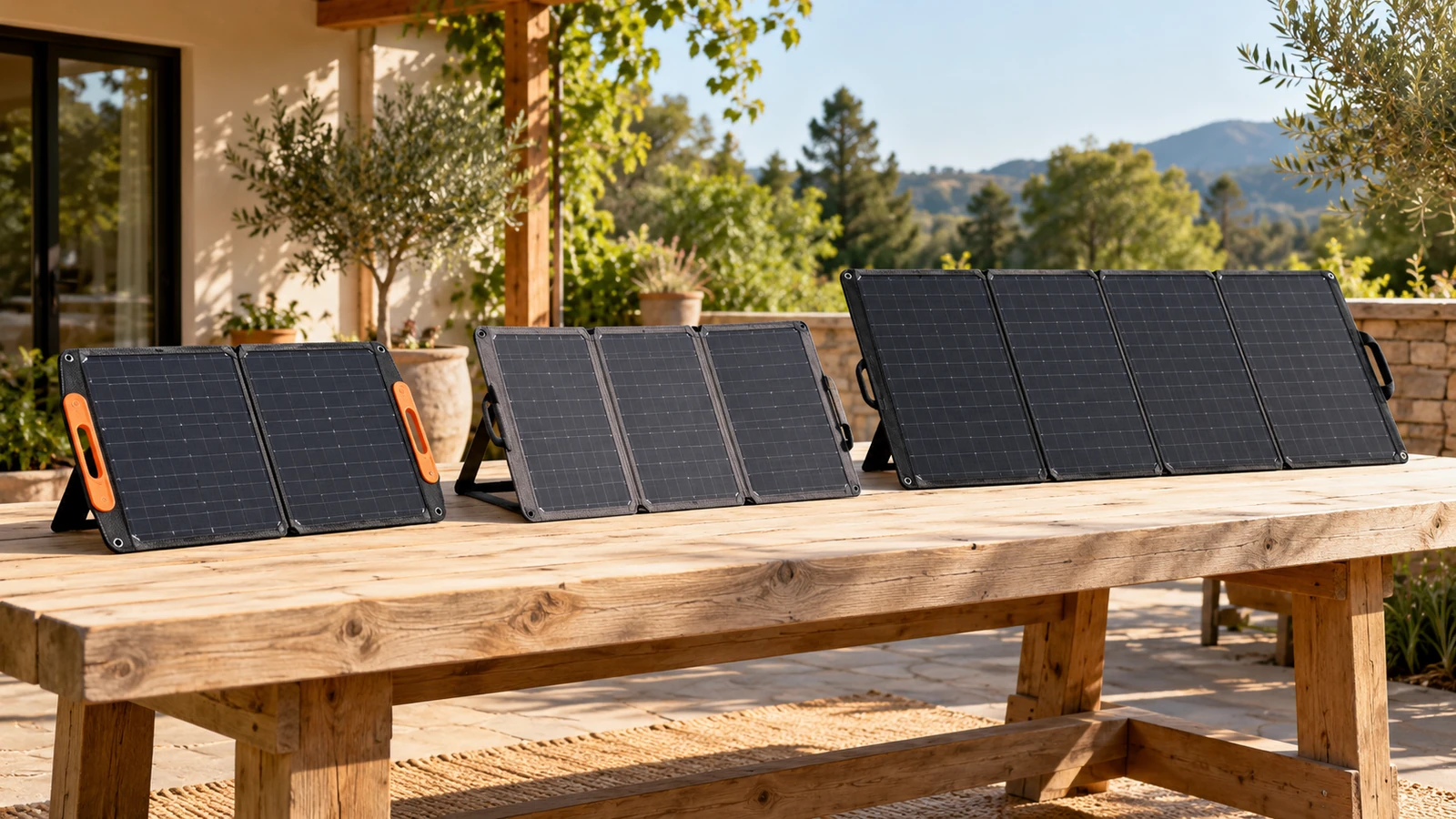
The hero is an AI-generated illustration of two-, three- and four-section panel types. It cannot verify cell count, rear construction, cable details or exact model dimensions. Confirm those on the delivered product and manual.
Sources
Sources and checks
Specifications, independent reporting and owner accounts are identified below. All pages were checked on 29 October 2026. Owner reports are anecdotes, not controlled tests; the notes identify model and edition limits.
-
01
UK government: be ready for emergencies
Checked 29 October 2026. Current basic kit advice prioritises accessible essentials and charged power banks. Portable solar is an optional replenishment method.
Open source -
02
Jackery UK: SolarSaga 100W
Checked 29 October 2026. Classic panel: 4.69kg, current electrical table, USB outputs and rain precautions. Do not substitute newer 100 Light/JS100C data.
Open source -
03
EcoFlow UK: 160W Lightweight Portable Solar Panel
Checked 29 October 2026. EF-FOLD-160-LW: three sections, 3.8kg, bifacial ratings, built-in cable, voltage/current limits and IP68 panel rating.
Open source -
04
EcoFlow: 160W Lightweight panel manual, May 2026
Checked 29 October 2026. Manufacturer-authored manual hosted by a specialist dealer. STC/BNPI electrical ratings and operating instructions for the new lightweight model.
Open source -
05
BLUETTI: Premium Series technical flyer
Checked 29 October 2026. Manufacturer table for classic PV200: 200W, 26.1V open circuit, 9.7A operating current and 7.3kg. Corrects misleading Amazon weight text.
Open source -
06
Amazon UK: classic SolarSaga 100W and owners
Checked 29 October 2026. £239 new, in stock from Jackery UK. Classic-family owners describe angle, wind and weather sensitivity; older variants are not controlled output tests.
Open source -
07
Amazon UK: EcoFlow 160W Lightweight offer
Checked 29 October 2026. £199 new buying option from EcoFlow Germany GmbH; orderable but quoted delivery 18–19 November. Older four-section reviews are not evidence for this revision.
Open source -
08
Amazon UK: classic BLUETTI PV200 and owners
Checked 29 October 2026. £399 new, in stock from BLUETTI UK. Owners dated 16 January and 4 March 2026 report straightforward use; merged wattage variants excluded.
Open source -
09
Ken Rockwell: classic SolarSaga 100W review
Checked 29 October 2026. Independent older classic-panel examination of the DC7909 connection, USB limitations and handling. Not a test of every current manufacturing revision.
Open source -
10
Caravan and Camping Australia: PV200 review
Checked 29 October 2026. 22 November 2022. Classic PV200 field review; reported up to 185W in Australian conditions. Supports handling assessment, not UK winter yield.
Open source -
11
Australian Government: solar panels explained
Checked 29 October 2026. Qualified explanation of panel ratings, sunlight and environmental effects. Nameplate output is measured under reference conditions.
Open source -
12
University of Queensland: weather and local environment
Checked 29 October 2026. Technical explanation of shade, temperature and weather effects. Used for realistic output assumptions and cold-voltage caution.
Open source
Guide information and links checked 29 October 2026.