Research-led buying guide · Household preparedness
Best portable power stations for home power cuts
A small battery can cover phones and lights; a 1kWh station buys a larger reserve. Choose by measured loads, usable energy and local electrical compatibility.
Quick answer
Best portable power stations for home power cuts: the short answer
Choose the smallest reserve that covers your essential devices. The £499 Jackery is the value step up when 245Wh is too little.
- 01
Pick RIVER 3 for lightweight, low-power backup.
- 02
Pick Explorer 1000 v2 for a larger fixed reserve at the checked price.
- 03
Pick DELTA 3 Plus only if its higher output, dual solar inputs or expansion will be useful.
- 04
Keep warmth plans and critical-equipment arrangements independent of these optional batteries.
The picks
The researched shortlist
Three exact models, selected for different needs. Prices are snapshots of the Amazon UK source listings; country, seller, stock, delivery and promotions can change.
EcoFlow RIVER 3 245Wh, UK 10ms version
Best for: Phones, LED lights and a laptop during a shorter cut
At £199, the RIVER 3 is the easiest of these to carry between rooms. Its 100W USB-C output suits a compatible laptop without running the AC inverter. The 245Wh battery is a sensible step above a phone power bank when several small devices need charging.
- About 3.5kg: practical to move and store
- 100W USB-C avoids unnecessary AC conversion for compatible devices
- Lower purchase cost than the 1kWh options
- 245Wh is a short reserve, not whole-house backup
- 300W continuous AC and limited solar input
- No extra-battery expansion
Jackery Explorer 1000 v2, UK 1070Wh
Best for: Several devices or a compatible fridge after a load check
The Jackery offers over four times the RIVER’s nominal energy for about two and a half times the checked price. Its 1500W normal output covers a wider set of appliances, while 10.8kg is manageable for many adults using the carry handle. It is the strongest value here if you need stored energy more than expansion.
- 1070Wh gives a meaningful increase in stored energy
- 1500W normal AC output handles more appliance types
- Lower checked price and weight than DELTA 3 Plus
- 10.8kg is still a substantial lift
- No compatible extra-battery expansion
- Inverter idle consumption matters with tiny loads
EcoFlow DELTA 3 Plus, UK 1024Wh
Best for: Households that will use dual solar inputs or later battery expansion
The extra £200 over the Jackery buys higher normal output, two 500W solar inputs and a route to compatible extra batteries. That can be useful if you already have an outdoor charging plan. Two 140W USB-C ports also suit modern laptops. Choose it for those capabilities rather than expecting substantially longer runtime from its built-in battery.
- Two independent solar inputs, up to 1000W combined within limits
- Compatible extra batteries provide a future expansion route
- 1800W normal AC and two 140W USB-C outputs
- £699 and 12.5kg before panels or extra batteries
- Built-in capacity offers no runtime step up over the Jackery
- App settings and extra-battery compatibility need checking
Start with the household need
Start with the household need
The UK government’s power-cut guidance starts with communication, light and warmth. A charged phone power bank, LED torch and existing bedding may cover a short interruption. None of these stations is a required part of basic preparedness.
Write down what must stay on, its measured watts and how many hours you need. Separate phone charging from continuous loads such as a router, optical network terminal (ONT) or fridge. A plug-in energy meter can reveal a fridge’s average use over a day; its motor may also need a brief starting surge well above that average.
Buy a larger system only when this list justifies it. Keeping one occupied room comfortable with clothing and bedding usually stretches a battery much further than running electric space heating. See the Home & workshop category for related household equipment.
What the capacity can realistically deliver
What the capacity can realistically deliver
Watt-hours (Wh) measure stored energy; watts (W) measure the rate at which an appliance uses it. The number on the box is not all available at a mains socket.
Independent reviewers measured 202.5Wh AC from a RIVER 3 at 270W, 910Wh from an Explorer 1000 v2 and 910Wh from a DELTA 3 Plus. These were separate tests of China/US editions, with different methods. They establish that conversion losses matter; they do not rank UK low-load endurance. We have not tested these products.
For a deliberately cautious illustration, assume 80% of nominal capacity reaches AC loads and allow 10–20W of inverter overhead. These are planning assumptions, not measured idle figures for every station; Jackery itself gives an 18W standby example.
- A continuous 20W essential load gives roughly 5–6.5 hours from the RIVER, 21–28.5 hours from the Jackery and 20.5–27 hours from the DELTA.
- A continuous 100W load gives about 1.6–1.8 hours, 7–8 hours and 7 hours, respectively.
- The calculation is nominal Wh × 0.8 ÷ (load W + overhead W). Cold, ageing, reserve settings, high loads and incomplete charging can reduce these figures.
Use direct USB-C for a compatible laptop where possible. Do not assume a station’s 12.6V vehicle output is interchangeable with a router’s regulated 12V input. Match the device specification and connector.
A 1500W heater could exhaust a 1kWh-class station in roughly half an hour after losses. A fridge may run much longer because its compressor cycles, but only a measured consumption figure and successful startup test justify a runtime plan.
Check ports, charging and regional voltage
Check ports, charging and regional voltage
All three selected offers are UK 230V/50Hz versions. North America commonly uses 120V/60Hz; Japan commonly uses 100V with regional frequency differences. Other countries use different sockets and electrical standards. Buy a locally supported version. A travel plug adapter does not convert voltage or frequency, and a station’s UK AC input is not automatically universal.
- RIVER 3: 300W normal pure-sine AC; USB-C up to 100W. Solar is 11–30V, 8A and 110W maximum through its XT60 input.
- Explorer 1000 v2: 1500W normal/3000W surge AC; USB-C up to 100W and 30W. Each DC8020 solar input accepts 16–60V, up to 10.5A and 200W; two together allow 400W. Follow Jackery’s matching-panel instructions.
- DELTA 3 Plus: 1800W normal/3600W surge AC; two USB-C outputs up to 140W each with suitable devices and cables. Each XT60i solar input accepts 11–60V, up to 15A and 500W. The vehicle and barrel DC outputs share a 126W total limit.
“600W” RIVER and higher DELTA X-Boost advertising describe special modes that can reduce output voltage for certain loads. Use the normal rating when choosing equipment. Surge ratings are brief allowances, not continuous capacity.
The selected RIVER and DELTA advertise around 10ms backup transfer; Jackery specifies 20ms. A device can still restart during transfer. Test your actual load by disconnecting incoming mains under safe conditions. These are not certified medical-backup recommendations; arrange critical-equipment continuity with its supplier.
Fast mains recharge claims assume suitable temperatures, settings and a healthy supply. Follow the manual’s storage and maintenance schedule, keep ventilation clear, and check charge before forecast disruption. These LiFePO4 models should not be charged below their specified minimum, generally 0°C. Portable solar charging is weather dependent and needs a separate compatibility check.
Safe use
Use a station as a portable appliance supply
A portable battery can power connected appliances. Supplying fixed house wiring is a separate electrical project.
- Never connect a station’s outlet to a wall socket to feed a home circuit. Fixed circuits, boilers and transfer equipment need a qualified installer and local-code compliance.
- Keep the complete station dry, upright and ventilated, with cables clear of escape routes. A protected internal battery pack does not make exposed sockets weatherproof.
- Match continuous demand, brief surge, connector polarity and every input limit. Do not assume a solar adapter makes any panel electrically compatible.
- Powering a router and ONT cannot guarantee that the wider broadband network or mobile masts will remain available.
- Use only compatible charging equipment. Do not run fuel-burning generators, barbecues or camping stoves indoors to recharge or heat the home.
Our method
How we chose and where evidence stops
This is desk research checked on 29 October 2026, not hands-on testing. We prioritised clear regional manuals, LiFePO4 batteries, useful normal output and credible evidence of usable energy. The three tiers represent a small reserve, a larger fixed reserve and an optional expandable platform.
The exact Amazon UK pages were opened to verify ASIN, edition, new price and availability. Repeated owner themes informed handling and setup cautions; anonymous runtimes and merged variant ratings were not treated as measurements. The independent tests are credited to their publishers and limited to their tested editions.
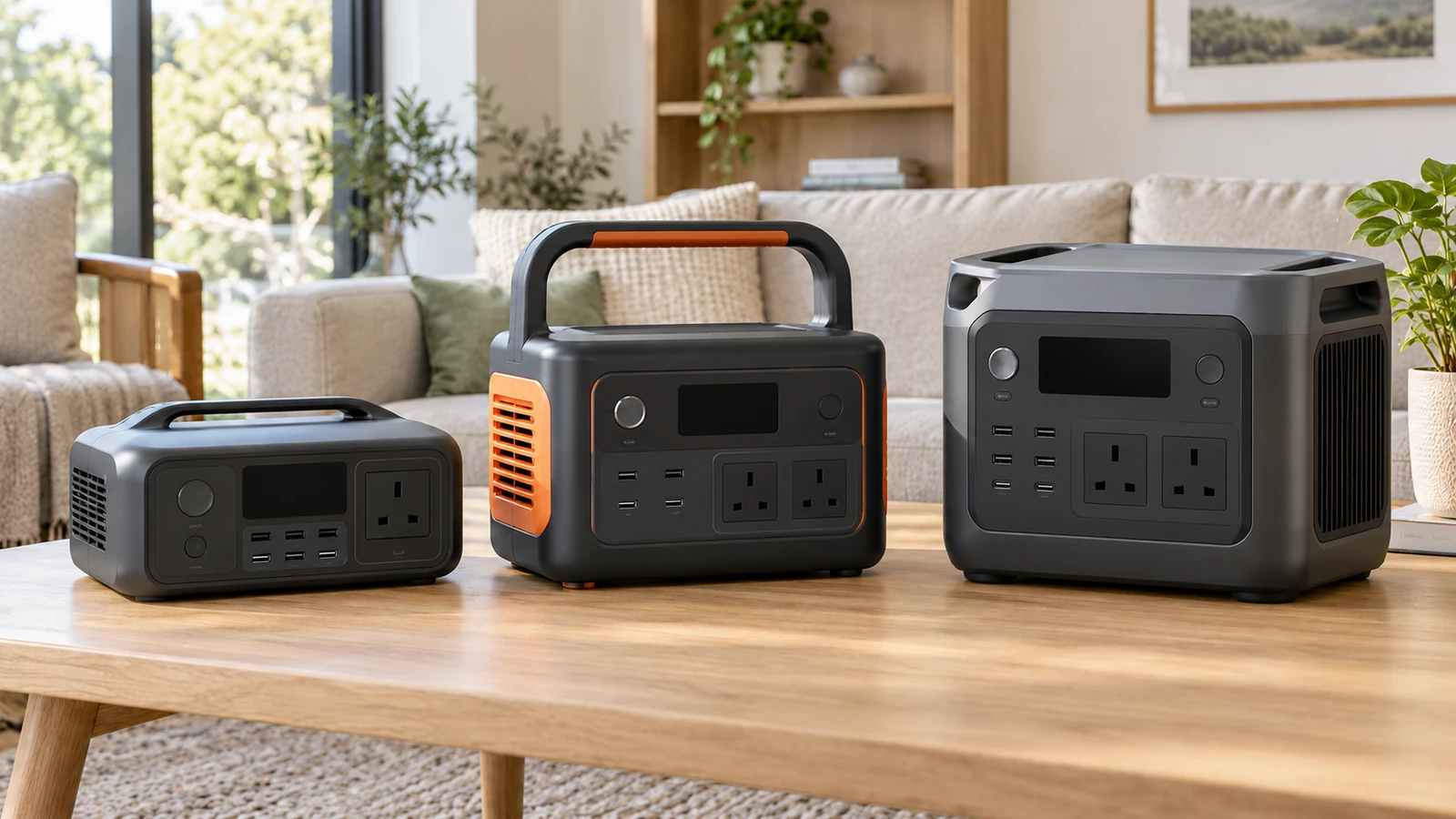
Prices were £199, £499 and £699, respectively, before any later promotions or delivery changes. Solar panels, extra batteries and specialist cables are not included in these station-only recommendations. The hero is an AI-generated, representative product-type lineup; it does not establish exact port counts, branding or scale.
Sources
Sources and checks
Specifications, independent reporting and owner accounts are identified below. All pages were checked on 29 October 2026. Owner reports are anecdotes, not controlled tests; the notes identify model and edition limits.
-
01
UK government: preparing for power cuts
Checked 29 October 2026. Current official preparedness advice: lighting, communications and keeping warm. A large power station is an optional upgrade.
Open source -
02
EcoFlow RIVER 3 user manual
Checked 29 October 2026. EFR705: capacity, normal output, solar limits, temperature limits and regional variants. Check the UK 245Wh/10ms edition.
Open source -
03
Jackery: Explorer 1000 V2 basic information
Checked 29 October 2026. Updated 10 July 2026. Battery, DC8020 inputs, charging modes and standby consumption. Regional socket counts vary.
Open source -
04
EcoFlow DELTA 3 Plus user manual
Checked 29 October 2026. UK electrical ratings, dual solar inputs, shared DC limits, expansion and charging precautions; Plus differs from base DELTA 3.
Open source -
05
Power Station Tips: RIVER 3 instrumented review
Checked 29 October 2026. Steve Wang, 14 July 2026. China 220V/10ms unit: 202.5Wh AC at 270W and 216.8Wh USB-C at 97.6W. Not a UK sample.
Open source -
06
OutdoorGearLab: Explorer 1000 v2 review
Checked 29 October 2026. Kenji Mowrey, 23 July 2026. Measured 910Wh in its test. US edition; useful loss evidence, not a UK runtime guarantee.
Open source -
07
StorageReview: DELTA 3 Plus review
Checked 29 October 2026. Dylan Dougherty, 2 January 2025. US unit delivered 910Wh; measured transfer just over 8ms. Follow UK manual for ports and voltage.
Open source -
08
Amazon UK: RIVER 3 245Wh 10ms listing and owners
Checked 29 October 2026. £199 new, in stock, EcoFlow Germany GmbH. Owner accounts dated 10 January 2025 and 15 March 2026 describe small networking loads; loads and runtimes differ.
Open source -
09
Amazon UK: Explorer 1000 v2 listing and owners
Checked 29 October 2026. £499 new, in stock, Jackery UK. Owners dated 23 September 2025, 5 February and 9 June 2026 recur on useful portable power, weight and extra cable costs.
Open source -
10
Amazon UK: DELTA 3 Plus listing and owners
Checked 29 October 2026. £699 new, in stock, EcoFlow Germany GmbH. Owners dated 24 July and 7 October 2025 praise charging; 25 October 2026 notes app setup/charging variation.
Open source -
11
EcoFlow UK: DELTA 3 series
Checked 29 October 2026. UK product comparison distinguishes Plus dual 500W inputs and compatible extra batteries. Fast-charge figures require stated conditions.
Open source
Guide information and links checked 29 October 2026.