Household emergency preparedness
Best first aid kits for home emergencies
Start with the first aid supplies you already use. These three kits offer a dressing reserve, a compact grab-bag pouch or better organisation, with the contents gaps made clear.
Quick answer
Which first aid kit makes sense at home?
The best first aid kits for home emergencies make everyday dressings easy to find and replace. Choose the Reliance case for a cupboard, the Trek when space is tight, or the Adventurer for a more organised portable kit.
- 01
Keep an adequate existing kit and replace missing or expired items; a new branded case is optional.
- 02
Choose by useful contents and access, rather than the number of pieces or a “10 person” label.
- 03
None of these contains your household’s prescribed medicines or a complete emergency medical provision.
Before buying
A useful kit does not need to be new
Current UK government guidance recommends building supplies gradually for at least three days. A household first aid kit belongs alongside that preparation; it cannot replace medical care, training or your normal medication plan. Local emergency advice takes priority wherever you live.
A clean, clearly marked box or pouch containing suitable, in-date supplies can be enough. Keep sterile items in their intact original wrappers. Choose a dry, accessible cupboard that adults know about, away from heat and small children. A medical cross or tidy organiser is useful only if people can find what they need.
St John Ambulance's checklist is a better starting point than a large piece count. Check dressings, plasters, disposable gloves, bandages and the small tools your family actually needs. Allow for allergies, suitable glove sizes and children. Keep prescribed treatments separately identifiable, with their own storage and refill arrangements.
The picks
The researched shortlist
These are three different formats, rather than a compulsory spending ladder. Prices are one-time Amazon UK offers checked on 29 October 2026; stock, sellers, delivery and prices vary by country. No premium kit is included simply to make the range look complete.
Reliance Medical HSE 10 Person First Aid Kit (Aura / Ref 112)
Best for: A home cupboard with room for a rigid case
The documented Ref 112 contents put the money into plasters, wound dressings and triangular bandages rather than small extras. A rigid, conspicuous case is easy to keep in a known cupboard. It is a sensible starting point if you already own suitable scissors and tweezers; it is less convenient than the pouches in a small grab bag.
- Six medium and two large dressings in the published inventory
- Four triangular bandages and two eye-pad dressings
- Rigid case keeps a dressing reserve together
- No scissors, tweezers or adhesive tape listed
- Only one pair of disposable gloves listed; extra suitable pairs may be needed
- Older published specification does not guarantee the current shipped inventory
Lifesystems Trek First Aid Kit (1025)
Best for: A small portable pouch alongside a home reserve
The Trek combines scissors, tweezers, tape and a mixed dressing supply in a pouch about 14 × 11 × 5 cm. It saves space when a rigid case would be left behind. At the checked price it also costs less than the Reliance case, but buys portability rather than its larger dressing reserve.
- Small pouch is easier to fit into an existing grab bag
- Scissors, tweezers and tape are listed
- Includes both wound and blister dressing options
- Modest dressing reserve compared with the Reliance case
- No listed triangular bandage or thermometer
- Manufacturer and retailer contents descriptions differ
Lifesystems Adventurer First Aid Kit (1030)
Best for: A portable household kit that is easier to navigate
The QuickFind layout and larger pouch are the useful step up from Trek. The maker lists a triangular bandage, six saline wipes and a disposable thermometer alongside the small tools and wound supplies. Pay for a more navigable assortment if several adults may use it; do not expect a substantial medical capability upgrade.
- QuickFind layout separates supplies for easier retrieval
- Triangular bandage and small tools listed
- More saline wipes than the Trek
- Costs more without becoming a complete household medical kit
- Bigger pouch uses more grab-bag space
- Thermometer, glove and weight descriptions differ between current maker and Amazon pages
Contents and gaps
What the published contents actually include
Reliance: more dressings, fewer tools
The manufacturer's Ref 112 specification lists 20 assorted plasters, six medium and two large wound dressings, two eye pads, four triangular bandages, six cleansing wipes, one pair of gloves, eight safety pins and a guidance leaflet. It does not list scissors, tweezers or adhesive tape. This is a dressing-focused workplace format, not a full household checklist. The Amazon model code is 77501RM; the Ref 112 mapping is supported by the matching EAN on the cross-check listing.
Trek: a compact mixed assortment
The current maker list includes scissors, tweezers, six pins, woven and crepe bandages, five gauze swabs, Micropore tape, four saline wipes and two pairs of gloves. Dressings include a 12 × 12 cm wound dressing, 5 × 5 cm and 10 × 10 cm low-adherent dressings, an adherent dressing, assorted plasters, two blister plasters and one burn-gel sachet. No triangular bandage or thermometer is listed.
Adventurer: organisation and a few useful additions
The current maker list adds a triangular bandage and lists a disposable thermometer. It includes scissors, tweezers, six pins, woven and crepe bandages, six saline wipes, tape, five gauze swabs, two pairs of gloves, assorted and blister plasters, a medium wound dressing, two low-adherent dressings, burn gel and a leaflet. Its QuickFind layout is the main reason to spend more.
Check the supplied inventory before relying on it
The Reliance specification is revision January 2019 and allows component changes. Lifesystems' current pages specify nitrile gloves, while the Amazon descriptions say vinyl. The Trek listing mentions an eye pad absent from the current maker list; the Adventurer listing mentions closure strips but does not confirm the maker-listed thermometer. Do not count on those disputed extras. Compare the sealed kit with its supplied contents card on arrival, check dates and glove material, and resolve any missing essential before putting it away.
Useful additions
What these kits do not solve
None lists a bottle of eyewash, a foil blanket or a CPR face shield. Whether to add one depends on the household and your training; a long list of specialist tools is not automatically helpful. Check whether you already have a reliable thermometer and suitable scissors before buying duplicates. None of the three provides a household supply of medicines. Ask your pharmacist about sensible arrangements for regular medication and any temperature-sensitive treatment.
Burn-gel sachets do not replace proper cooling. NHS burns guidance advises cooling a burn with cool running water for 20 minutes and obtaining help for serious burns. Read current local first aid advice and learn how to use the kit before an outage. For serious injury, seek urgent help using the emergency number where you live.
Do not assume “HSE”, a person count or an Amazon category label means a complete household kit or current BS 8599 compliance. The Reliance selection is an older HSE contents format; the recommendation is for its practical dressing supply, not a certification claim.
Expiry and care
Check individual expiry dates, not just the case
St John Ambulance recommends regular checks, including a six-month review. Replace supplies after use and inspect them sooner after damp storage or damage. Record the earliest relevant expiry on a card inside the lid and keep an inventory so replenishing one item is straightforward.
Sterile dressings and wipes can expire while the reusable pouch remains sound. Replace expired, open, wet or damaged sterile packs. Reliance's document states five years from manufacture; that does not promise five years remaining on an Amazon purchase. Ask about short-dated stock if that matters, and check every dated component when it arrives. Do not discard an otherwise useful case merely because one consumable needs replacing.
Store paper instructions where they remain readable and put a small copy of essential contact information nearby. A periodic check is also a chance to practise locating gloves and dressings without emptying the kit.
Our method
How we chose and what the evidence can show
This is a research-led comparison, with no original hands-on testing. We checked exact Amazon ASINs and offers against manufacturer contents lists and first aid advice. The Reliance product code was cross-checked through an EAN-linked retailer record because Amazon uses a distributor code. Current maker lists take precedence over unexplained marketplace extras, but do not establish what is inside a particular sealed shipment.
Auto Express's recent comparison used qualified emergency-care reviewers to assess other first aid kits. It informed our focus on useful dressings and access; its test results are not attributed to these three products. Multiple Amazon owner comments on the Lifesystems pouches describe convenient size and the need to tailor contents. They support those practical observations, not clinical effectiveness or sterility. No independently controlled comparison of these exact three kits was found.
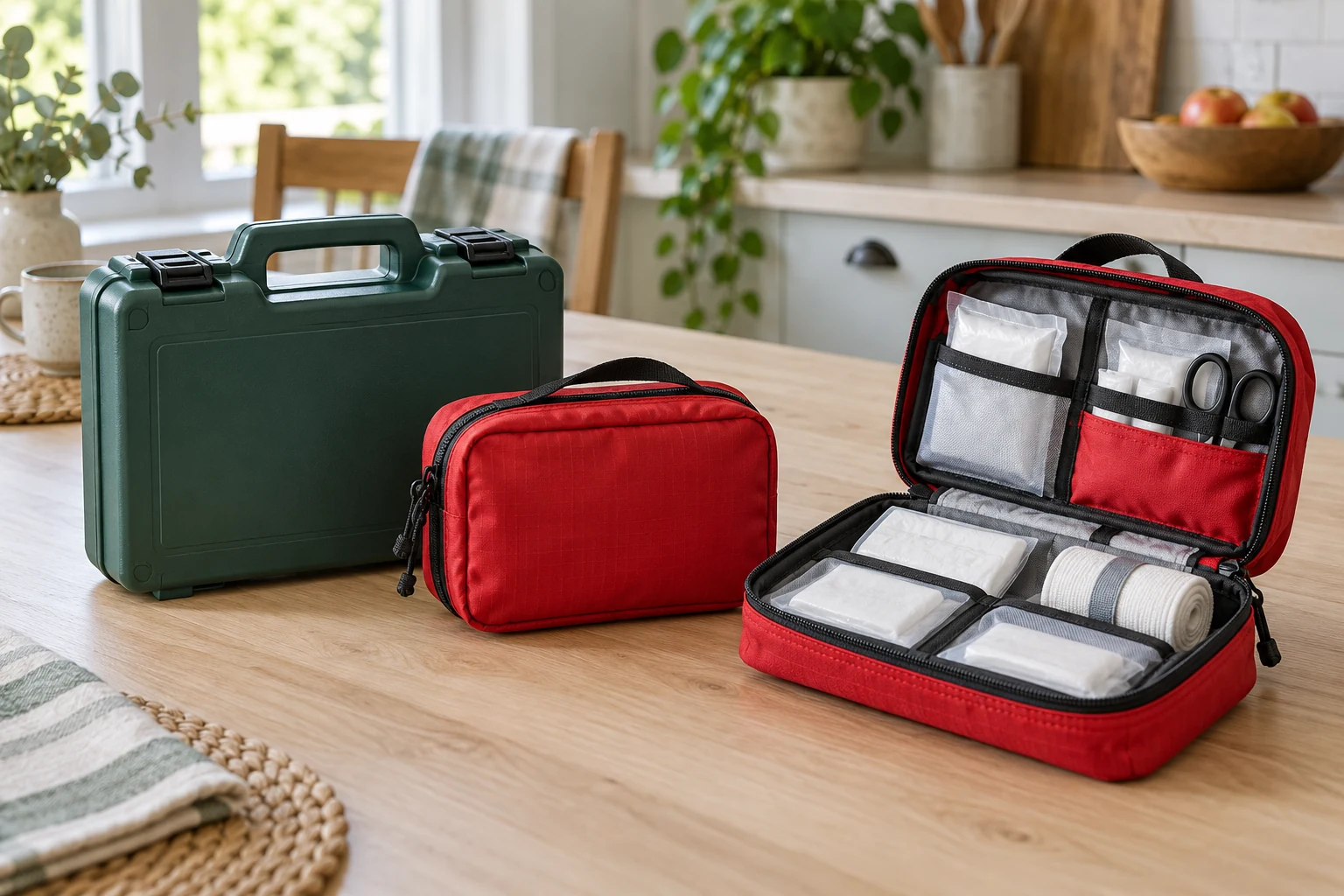
We considered larger general-purpose kits but found no household benefit sufficient to justify a forced premium recommendation. A search of The Hobby Library found no directly matching household first aid activity. The hero is a generated illustration of the three kit formats, not a photograph documenting their contents.
Sources
Sources and checks
All pages below were checked on 29 October 2026. Publication dates are recorded where available. Manufacturer claims, independent observations and owner comments are distinguished in the notes.
-
01
UK government: Be Ready for Emergencies
Current official household preparedness guidance.
Open source -
02
St John Ambulance: first aid kit checklist
Qualified first aid supplier checklist; household contents and tailoring context.
Open source -
03
Reliance Medical: HSE workplace kit specification, Ref 112
Manufacturer PDF hosted by Arco; revision V1 January 2019. Counts, EAN, storage and five-year manufacturing shelf life; components may change.
Open source -
04
Lifesystems: Trek current contents
Current maker inventory and pouch specification; glove and eye-pad differences from Amazon are disclosed.
Open source -
05
Lifesystems: Adventurer current contents
Current inventory, QuickFind organisation, dimensions and listed thermometer; discrepancies are disclosed.
Open source -
06
Amazon UK: Reliance HSE kit, B001MF3T28
Live one-time £17.86 Amazon offer, in stock; model 77501RM. Marketplace wording does not establish full contents.
Open source -
07
Amazon UK: Lifesystems Trek, B0015NQLNQ
Live £15.99 Amazon offer, in stock. Multiple owners describe compactness and useful basic contents; comments are not medical validation.
Open source -
08
Amazon UK: Lifesystems Adventurer, B0015NMPVS
Live £26.99 Amazon offer, in stock. Owner reports support portability and tailoring, with no inference of clinical performance.
Open source -
09
St John Ambulance: do first aid kits expire?
Expiry and six-month inspection guidance. A reusable container and its dated consumables have different replacement needs.
Open source -
10
NHS: burns and scalds
Current clinical guidance for cooling burns and seeking help; burn gel is not a replacement for cooling.
Open source -
11
Auto Express: best first aid kits
Recent independent comparison with qualified emergency-care reviewers. Different kits; used only for selection criteria, not rankings of these picks.
Open source -
12
OnBuy: Reliance Ref 112 identifier cross-check
Links distributor code 77501RM to EAN 5060131881126, matching the manufacturer Ref 112 specification. Not a recommendation link.
Open source
Guide information and links checked 29 October 2026.